 The youth and upper middle class today is not interested in voting. The reason they give is that " All candidates and parties are alike and they all are corrupt". Many wish Section 49-o to come into existence so that they can chose "none of the above" option.
Thinking that all candidates are corrupt is often a case of ignorance. In mumbai a leading surgeon and an investement banker (both women) stood this time but most probably they will lose this time as the "educated and urban middle class" which should have been their vote bank didn't come out to vote because of two reasons-
1.) They didn't know about them
2.) They didn't have the will to vote
So for people who think that they will not vote this time because there is no suitable candidate (in chd) take a look at this website http://www.ajaygoyal.in/ of Candidate Ajay goyal.
He is an independent candidate and does not belong to any party. Other details, manifesto, qualification etc all can be found at the website. So if you think BJP and Congress doesnt deserve your vote atleast dont let it go waste and vote for some deserving candidate.
We all know that it is very unlikely that he will win this time but instead of not voting people should vote for the right candidate.
What will it do?? How does it matter??
If the voting %age is high the political parties will come to know that Urban middle class and youth is a vote bank and they vote for clean politicians so they will field candidates accordingly. More and more good people will come to politics knowing that good and aware people will vote for them.
Remember at the end of day A politician is as good as people who vote for him. If you want illiterate, poor, corrupt, thieves, criminals etc to vote for the good candidate while you enjoy your election holiday and sleep THAT IS JUST NOT GOING TO HAPPEN. So atleast vote someone to show that educated middle class is also a vote bank that cant be manipulated.
DISCLAIMER:- I am not associated with the candidate nor I am campaigning for him. I came to know about this candidate so made a post to tell people about less known candidates in Chd. If anyone know any other good candidate they can mail me and I will add them too.
Jai Hind

The Internet these days is flooded with articles about SECTION 49-o. People are sending and recieving emails and social networking websites like Orkut and Facebook are flooded with topics on Section 49-o. The HOAX mail claim that under section 49-o we can choose the option of not voting anyone and if the no. of persons voting for none of the above exceed the other voting percentage all candidates will be disqualified and Re-Polling would be held with new candidates. Unfortunately many people didn't thought of verifying this and spread the rumour forward which created lots of confusion.
So what is the truth??
The truth is Section 49-o exist and its purpose as per paragraph given on Indian govt. website is-
49-O. Elector deciding not to vote.-If an elector, after his electoral roll number has been duly entered in the register of voters in Form-17A and has put his signature or thumb impression thereon as required under sub-rule (1) of rule 49L, decided not to record his vote, a remark to this effect shall be made against the said entry in Form 17A by the presiding officer and the signature or thumb impression of the elector shall be obtained against such remark.
Implementation- The real inclusion of article 49-0 in the rule book is to prevent election fraud, so that other people don’t caste their vote using your identity. The Election Commission didn’t bother extending it further specifying what would happen in case the number of “none” votes exceeded those of the other candidates.
So what is the myth?
The myth is that there is re-polling. The truth is that THERE IS NO RE-POLLING. The result will remain the same, the person who gets the highest number of votes wins. Which also means that even if the majority of the nation feels that amongst the candidates standing none of them fits the bill and none would do justice to the nation as the next PM, theres no rule (as of now) which will ensure re-polling.
So now you know the truth and the next time when someone tells you about section 49-o you know what you have to say!
Spread Awareness.
Jai Hind

The first family has other, perhaps bigger, reasons to worry, apart from about the Bofors slush money. Two more stunning exposures — but not as well-known as the Bofors scam — make the first family a target for investigation on slush money. Now on to the heart of the story which has three limbs.
First: $2.2 billions in Rajiv's secret accounts, says Swiss magazine
The shocking exposure came from Switzerland itself. The most popular magazine of Switzerland, Schweizer Illustrierte, [dated November 11, 1991] did an expose of 14 politicians of developing nations who, it said, had stashed their bribes in Swiss banks. The title of the expose in German read “Fluchgelder — Die Schweizer Konten der Dictatoren”. In English it meant, “Curse of money — The Swiss bank accounts of the Dictators”. Rajiv Gandhi figured in the expose as one with slush funds in secret accounts. Schweizer Illustrierte is not some rag. It is the Number One Swiss magazine and sells some 2,10,000 copies. Its readership is 9,18,000 — some 15 per cent of Swiss adults. The magazine had mentioned specific amounts in secret Swiss accounts of different leaders with their pictures alongside.
The report under the picture of Rajiv Gandhi, translated into English, read: "2.5 billion francs on the Indian secret accounts in Switzerland" of "Rajiv Gandhi, Indian". Today the amount of 2.5 billion Swiss Francs equals 2.2 billion US Dollars. But as Rajiv was no more by then, it must become the family inheritance. The other leaders captured by the magazine were: Suharto of Indonesia (25.5 billion), Haile Selassie of Ethiopia (22.5 billion), Mobutu of Zaire (6 billion), Shah Pehlvi of Iran (5.7 billion), Saddam Hussein of Iraq (800 million), and Nicolas Ceausescu of Romania (500 million). The figures of slush money mentioned were in milliarden (meaning ‘billions’) units of Swiss Francs. Had Rajiv been alive then, the expose would have caused a political tsunami in India.
The box item above shows the pictures and the amounts of the leaders as appearing in the magazine.
More than the slush money charge it is the family's silence about it, which is baffling. The number one magazine in Switzerland had made the damning charge that Rajiv Gandhi had left behind slush funds of $2.2 billion and yet the family has kept mum for 18 years now. How could any honest person tolerate such a serious charge? Well, one could say that the family might not have challenged it because it was published in far away Switzerland. But Dr Subramanian Swamy had included the Schweizer Illustrierte expose in his write-up “Do You know your Sonia?” in his party, the Janata Party, website, seven years ago, in 2002. It is still on the Party's website. Photocopies of the expose in the Swiss magazine are shown at pages 51 to 53 of Dr Swamy's write-up; also an e-mail from the magazine addressed to Dr Swamy on February 22, 2002 at page 50. The e-mail confirms what the magazine had reported.
The e-mail reads:
“Dear sir,
We refer to your e-mail of April 4, regarding an article in our magazine Schweizer Illustrierte of November 11, 1991. In this article — Fluchgelder - Die Schweizer Konten der Dictatoren — is Rajiv Gandhi named with tot 2.5 Milliarden CHF on secret accounts. If you want the magazine please indicate the exact address.
Yours faithfully,
Ringer Ltd.
Margot Todisco”.
The fax and telephone numbers of Margot Todisco are also given in the mail. The e-mail is in box alongside here. Yet no one from the Congress or from the family has sued Dr Swamy till date, nor challenged him. The Swiss expose also prominently figured in the advertisement that some NRIs had put out in the New York Times to protest against Sonia Gandhi when she visited the US in the year 2007. The Indian National Overseas Congress (INOC) filed a defamation case against the ad, expressly "not to defend itself, but Sonia Gandhi". The New York Supreme Court dismissed the case holding that only Sonia Gandhi, not the INOC, had the locus to sue. But she would not dare sue. Thus, neither in Switzerland where Schweizer Illustrierte exposed Rajiv's secret account with billions 18 years ago in 1991, nor in India where Dr Swamy had put it on his party's website seven years ago in 2002, or in the US where the NRIs had boldly advertised the expose two years ago in 2007, would the Gandhi family challenge the expose.
In criminal law the conduct of the accused is an important piece of evidence. What does the family's conduct show here excepting that it has something to hide.
Second: family benefited from KGB, says book
The second expose, Rajiv Gandhi figuring again, is that the first family of the Congress accepted political payoffs from the Russian spy outfit, the KGB. In a highly acclaimed book The State Within a State: The KGB and Its Hold on Russia-Past, Present, and Future by Yevgenia Albats, a journalist on Moscow News and Izvestia, the author writes: “A letter signed by Victor Chebrikov, who replaced Andropov as the KGB head in 1982, noted: the USSR KGB maintains contact with the son of the Premier Minister Rajiv Gandhi (of India). R Gandhi expresses deep gratitude for the benefits accruing to the prime minister's family from the commercial dealings of the firm he controls in co-operation with the Soviet Foreign trade organisations. R Gandhi reports confidentially that a substantial portion of the funds obtained through this channel are used to support the party of R Gandhi.” (p223) The author also cites the KGB letter and file reference. In Dr Swamy's write-up on Sonia, KGB’s letter in Russian is attached at page 45 and its English translation at pages 43 and 44.
The letter says that Rajiv Gandhi himself has admitted that “benefits” accrued to “the prime minister’s family” from commercial dealings through Russian co-operation. All major newspapers, The Hindu and Times of India included, had carried the expose on KGB payments. The book State within a State on KGB was published in 1994.
Yet, no one from the Gandhi family has challenged it for 15 years now. Dr Swamy had included it in his expose on Sonia on his party's website since 2002. Yet the family has not challenged him or sued him for seven years. It was again made part of the NRI advertisement in New York Times in 2007 when Sonia Gandhi visited the US.
Even then only a proxy case was filed to defend Sonia Gandhi's reputation which was promptly saying only Sonia could defend her honour, which she would not.
Third: Bofors slush payoff to ‘Q’
Ottavio Quottrocchi, the star actor in the Bofors scam, is indistinguishable from Sonia’s family. His association with the family is as old as Sonia’s.
Even Sonia Gandhi cannot dispute that Q got the first instalment of $7.3 million out of the total bribe of $36.5 million (Three per cent of the contract value of $1.2 billion) due to his front company for swinging the gun deal for Bofors. The slush money of $7.3 million was traced to Q’s account by the CBI which got it frozen some 20 years ago. But when the law was closing in on Q in early 1990s, the Congress government stealthily allowed him to escape from India. He turned fugitive, but his slush money had continued to remain frozen.
Sten Lindstorm, the Swedish police official who investigated the Bofors case for 18 years, wrote an article in 2004, saying that Sonia should be interrogated in the Bofors case, particularly on her family's relations with Q, on who introduced Q to Bofors and why did Bofors pay him for deal with India. This article had appeared in several media in India. Subsequently, the CBI, obviously under pressure, quietly allowed Q to smuggle away his slush money from the frozen account.
The UPA was in power then, with Sonia Gandhi as chairperson of the National Advisory Council and also of the UPA. Could this happen unless she had wanted it? She owes an answer to the nation. But, far from answering any question, she asked the media, as early as in 1999, to show evidence against Q, when the most clinching evidence, the loot caught in Q's frozen account, had fixed him conclusively.
Yet, she defended him even after the Swiss court once, the Delhi High court twice and the Supreme Court finally held him part of the Bofor's fraud. And now, in the final days of its rule, her government has shamelessly let Q off the hook by removing his name from global red alert. Because of the red alert he was always in danger of being caught and sent to India. Now that's off. This move to free Q seems to be linked to the slush money issue rising in crescendo in this election. It seems to be in the larger interests of the family — she has to protect 'Q', if he has to protect the family. Otherwise just before elections no government will take the unpopular decision of freeing Q from India's legal net abroad.
QED: It does not need a seer to say that the first family of the Congress party is a suspect; a target for probe.
Who will probe its billions? Rahul Gandhi has told an election rally in Hyderabad, “elect us, we will investigate”.
If that happens, the suspects will probe themselves!

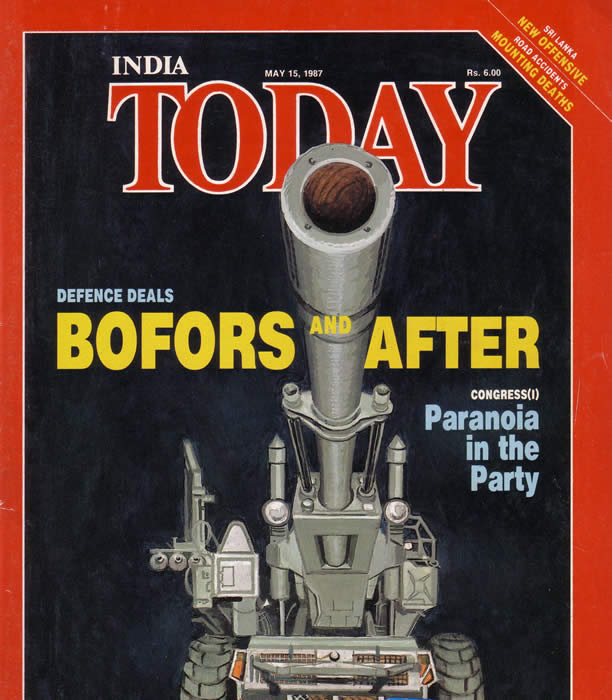
All must have heard about
BOFORS scandal in news recently or over the past few years. Some may not have any clue what is it all about while others may be thinking that BJP is flocking a dead horse and trying to gain votes by falsely levelling acquisitions.
I request all the people to read the following few paragraphs which will clear all the doubts like "what BOFORS scandal is" and "how congress is involved in it". It will just take 5 min to read the article. Lets spend atleast "5 min" for the nation.
-------------------------------------------------------------
The Quattrocchi case is an embarrassment for the Government of India... The court says we do not have a strong case”. It is not Antonia Maino (aka Sonia) Gandhi defending her Italian friend. It is Prime Minister Manmohan Singh as if she had appointed him as the advocate to plead for Q. “It’s not a good reflection on the Indian legal system,” says the PM moved by compassion for Q, “that we harass people while the world says we have no case.” Singh, who was with the South Commission on a comfortable salary and perks when the Bofors scam rocked the country, seems totally unaware of the facts of the Bofors scam. Here is a short trailer of the scam.
The Bofors scam — pay-off for India’s gun purchase deal with Sweden — broke out in 1987. A third of the Indians living today were not yet born then; and a fourth of the Indians living then are no more alive today. So some history needs to be recalled here. First, the Bofors payoff was exposed by the media and the Rajiv government went all out to suppress the exposure. Including the payoff of $36.5 million to Q, the Bofors deal contemplated three streams of payoff totalling $250 million. Persistent investigations by the media and the CBI brought out the involvement of Q in the gun deal.
The closeness of Q and his wife Maria to Sonia family was always well known.
The Sonia and Maria families spent their weekends and annual holidays together.
They left one’s children in the custody of the other when going out of station. So intense was their relationship. The media found that some $7.3 million from Bofors AB had found its way into Q’s secret bank accounts. Facts began to tumble out testifying that it was fee to Q for swinging the $1.2 billion gun deal for the Swedish gun maker.
Here is how Q got the deal for Bofors.
The Rajiv Gandhi government could not decide for a long time what gun to buy — the British, Austrian or Swedish. The two brokers engaged by Bofors could not expedite the deal. Suddenly, in the second half of 1985, AE Services (AES), a shell company, entered the deal with this offer to Bofors: “Look. If we get you the deal by March 31, 1986, give us a fee of three per cent. If not, don’t pay.” Bofors accepted the offer and signed up with the AES shell on October 15, 1985. Unless Bofors knew that the man behind AES had had the clout to get it done from the Rajiv government, it would never have signed with a shell company.
And AES shell did get the Rajiv government to sign the contract with Bofors on March 22, 1986 — seven days ahead of the target date of March 31, 1986. Within six months, AES got the first tranche of its fee of $7.3 million. Proof emerged slowly that this money finally went to Q, showing he was the man behind the shell.
■ Bofors remitted on September 3, 1986, $7.3 million into AES account number 18051-53 in Nordfinanz Bank, Zurich.
This equalled 20 per cent of the three per cent bribe of $36.5 millions due to AES.
■ Two weeks later (on September 16, 1986) AES delivered $7 million into account number 254.561.60W in the same bank in the name of Colbar Investments — a company controlled by Q and Maria.
■ In April 1987, the Swedish Radio broke the news of bribes in Bofors deal with India. Later, in June 1988, the media published authoritative documents seized by the Swedish police which established the payoff. By now, Bofors scam had become a huge national issue.
■ Forthwith Q and Maria hurriedly shifted their loot, grown with interest, from Geneva to Channel Islands, to New York to Austria. First, on July 25, 1988 $7.9 million moved from Colbar to account number 488.320.60X of Wetelsen Overseas SA, in UBS, Geneva. Next, on May 21, 1990, $9.2 million moved from Wetelson to account number 123983 of IIDCL, Ansbacher, St Peter Port, Guernsey (Channel Islands). Later, on June 5, 1990, $2.4 million channelled into code-named account ‘Robusta’ in Banque Karfinco SA from Swiss Bank Corp, New York. Afterwards, on June 12, 1990, $5.3 million was transferred to code-named accounts ‘Arabica’, ‘Robusta’ and ‘Luxor’ in Austria from Swiss Bank accounts in Geneva.
■ Within six days of the Swiss government giving these details to India in 1993, Q slipped out of India and turned a fugitive, thanks to the Narasimha Rao government helping him to run away.
■ Later, in June 2003, Interpol found that Q and Maria had two accounts, bearing numbers 5A5151516L and 5A5151516M in the London branch of the Swiss bank BSI AG with Euros three million and $1 million.
They were frozen on CBI’s request.
British courts later repeatedly turned down Quattrocchi’s several appeals to de-freeze the accounts.
■ But, on December 22, 2005, the Congressled UPA government U-turned. H R Bharadwaj, the law minister, got the additional solicitor general of India, B Dutta, to go to London to do the dirty job of releasing the amounts.
Can anyone say now that Q is innocent and he just received some charity of $7.3 million from Bofors? Yet the Sonia-led government allowed Q to smuggle the bribe from the frozen accounts. All that the CBI asks of Q is this: Come to India and answer these questions — why Bofors paid him the money; did it relate to the gun deal; what is his relation with Sonia family, AE Services, Colbar Investments and the coded and numbered bank accounts through which the payoff has finally reached him.
Why not Sonia Gandhi just ask him to appear before the court and prove his innocence? Why does she, on the contrary, abet his refusal to present himself before courts in India? It is clear that she will not ask him. Why? Here is the answer: unless Sonia protects Q here, he will not protect her outside. The stakes seem to be too high.
QED: Manmohan Singh today does what Sonia wants like Narasimha Rao did then what she wanted. Yet, there is a difference between how the two obliged her. Rao felt shy to do what she wanted. So he did it stealthily. Singh does what she wants openly and shamelessly. Even, a Sonia family retainer like H R Bharadwaj feels shy to own up the shameless withdrawal of the Red Corner Notice on Q; but the PM owns it proudly. Singh is shameless about what Rao used to feel shy. Why? Unlike Rao, Singh is not an elected prime minister but a nominated one; he is not chosen by democratic process, but selected by the dynasty; he is not backed by the people, but backed by the family. So the shift from shyness to shamelessness, from Rao to Singh.
comment@gurumurthy.net
About the author:
S Gurumurthy is a well-known commentator on political and economic issues.
Also see-
Black money stashed abroad and proof against congress
 When the Madoff fraud, one of the largest scams in Wall Street history, broke out, the US administration moved with lightning speed. Bernard L. Madoff, the founder of Bernard L. Madoff Investment Securities, accused of committing a $50 billion fraud on its clients, was arrested within hours of the scam unfolding on December 11, 2008 and later released on a $10 million bail. The assets of his investment firm were frozen the very next day. A federal court launched the prosecution proceedings forthwith and ordered liquidation of Madoff’s business. A receiver was appointed to manage the firm’s financial affairs. To protect the interests of cheated investors, the court directed the clients to seek relief under a federal statute created for the purpose. If convicted, Madoff could face up to 20 years in prison and a maximum fine of $5 million.
Look at the way India is dealing with its biggest corporate fraud committed by Satyam honcho Ramalinga Raju. He has simply gone underground after confessing himself to the Rs8,000 crore fraud. None knows about his whereabouts. And no attempt seems to be under way to trace him even two days after he dropped the bombshell. The Hyderabad police say they have no complaint to proceed against Raju. All that the Andhra Pradesh Chief Minister Rajasekhar Reddy did was to appeal for the intervention of the Prime Minister, who, in turn, responded to his Chief Minister’s plea with a stoic silence!
The government ’s response to the unfolding of the Satyam scam has been muted. It appeared to be totally clueless about what to do in the aftermath of the Satyam scam. The 52-year-old Companies Act doesn’t have any provisions that enable the government to take swift and effective action in cases of large scale fraud.
The Serious Fraud Investigating Office(sorry, I am hearing about this high-sounding office only now), to which the Satyam scam is being referred by the Government, says it could take up to a year or longer to complete the probe into the Satyam fraud. Well, Madoff must be envious of the freedom and immunity enjoyed by Raju even after committing the mother of all corporate crimes in India.
`Satyam’ in Sanskrit means `truth’ . `Satyameva Jayate’(Truth alone triumphs) is the national motto of India.In the case of Satyam Computers, it took seven long years for the truth to triumph. It is not yet clear if the discredited Satyam chief Ramalinga Raju has said the whole truth or only the half truth about the financial fraud in his statement to the board of directors.
It is not the Rajus alone who concealed the truth from shareholders. Prima facie, the auditors and the directors too were a party to the blatant suppression of truth.It is quite unlikely that internal auditors were not in the know of the financial wrongdoings perpetrated in Satyam for years. Can the auditors merely wash their hands of saying the book of accounts is a primary responsibility of the management and auditors merely audit the documents provided to them by the management. The auditors need to explain what process they adopted in authenticating the inflated profits and fictitious assets referred to by Raju. If Satyam’s auditor PwC is a willing accomplice in the scam, it is a shame on India’s chartered accounting profession as a whole.
How can it be that none of the board members, past or present, had any knowledge of the actual state of affairs in Satyam? Was the Company Secretary, who is supposed to act as an advisor to the board, too unaware of the developments? If he was aware, what advice did he give to the board?It is hard to believe that India’s fourth largest IT Company gave a complete goby to ethics, corporate governance and transparency by falsifying the company balance sheet, considered the most sacrosanct document of a corporate entity.
If 26/11 was the result of total failure of intelligence, Satyam fraud was in no less measure the result of the collapse of the corporate surveillance machinery. What were auditing regulators like the Institute of Chartered Accountants of India (ICAI) and the Institute of Company Secretaries of India (ICSI), as also the Ministry of Corporate Affairs, doing to bring about checks and balances in company auditing.
According to the Companies Act, auditors are to be appointed by shareholders at the companies’ AGM, but in most cases the shareholders are not even aware who their auditors are because they are appointed by the management. Most management is hesitant to share sufficient data with the investors so much so the investors don’t have a clear idea of the ground realities.
After the Satyam scam, the shareholders will tend to take the company balance sheets only with a large helping of salt.
Source: India Syndicate
 How many words do you speak during an average day? No, I am not talking about text messages, emails, or slang chatroom words, I am talking about words that actually come out of your mouth.
The average figure is 16,000 words. Even then, much of what we say can be meaningless chit-chat, brisk, necessary exchanges or even angry rants.
Here are ten things that we could all do with saying more often. While reading, I'll bet you believe the list is pretty simplistic. However, the positive impact they will have on your mood and your day is pretty dramatic.
1.) “Hello.”
How often do you sit silently next to someone on a train, or in a waiting room? How often do you stand tapping your foot in a line at the post office or bank? Just saying a simple “Hello” or “Hi” to the person next to you, and offering them a smile, could give you an instant mood-boost. And you might even get into a conversation to pass the time while you’re waiting.
2.) “Thank you.”
It’s hard to say “thank you” too often. Even when you feel someone’s performing a service that they should do by the nature of their job, thanking them will make both of you feel good. How about saying “thank you” to your employees or subordinates when they carry out a task for you, “thank you” to the girl at the checkout when she packs your bags for you, “thank you” to the waiter who brings your meals… Those two small words of gratitude can mean a lot.
3.) “Please.”
A word which we often associate with “thank you”, perhaps because we were taught to say both as young children, is “please”. Using this little word turns a demand into a request – and makes people much happier about fulfilling it. When you queue up for a coffee at Starbucks, don’t just bark “Venti Mocha Frappuccino” at the barista – add a “please”. When asking your partner to pass the salt at dinner, put in that “please”. It doesn’t just set a great example for your kids, it sets a tone of politeness and mutual respect.
4.) “Here, take my seat.”
Most of us are lucky enough to be fairly able-bodied and can easily stand on trains and buses without risking falling over. If you see someone elderly, pregnant or struggling in any way (perhaps a mother with a small child), offer them your seat. If you’re worried you’ll accidentally offend them, add a “I’m getting off soon” or something slightly jokey like “I could do with stretching my legs.”
5.) "This one’s on me.”
Out for drinks with a friend or acquaintance? Rather than insisting on splitting the bill straight down the middle, offer to buy for both of you. It’s nice to feel generous, and to feel that you’re receiving a gift – and your friend can reciprocate next time, if s/he wants. A note of caution: if you are a lot better off financially than your drinking partner, be sensitive about this.
6.) “Let me help you with that.”
If you see someone struggling, offer to help. They may rebuff you, but most people will be touched and grateful – you’ll get to make their day a little bit easier, which will put a dash of joy into yours. You might offer to help someone who’s:
->Struggling with getting a wheelchair up or down steps
->Lifting heavy luggage onto a train
->Carrying an overladen tray across a café
->Having difficulties reading a notice or leaflet
->Keep an eye out for other situations where you can make yourself useful!
7.) “I don’t think we’ve met. I’m [name].”
Many of us aren’t great at introducing ourselves. If you meet someone new, don’t just mumble about the weather or say nothing but “hi”; tell them your name, and ask theirs. It’s awkward to talk to someone for ten minutes before having to say “Sorry, I didn’t catch your name,” so be confident and upfront when meeting new people.
8.) “What I’m really passionate about is…”
So often, conversations revolve around matters of little consequence to both the speaker and the listener. If you feel that most of what you say is just small talk, try going deeper. Obviously, this doesn’t mean boring the person next to you on the bus with your entire life story – but when you’re getting to know someone, share some of your hobbies and interests, or tell them about your big life plans. You never know, you might have found a kindred spirit.
9.) “Have a great day!”
Although phrases like “have a nice day” can be overused by shopworkers and telesales staff, it’s still worth wishing people a good day, evening or weekend when you part. Speak with genuine enthusiasm, and you’ll almost certainly get a smile and a “thanks, you too!” in response – a great way to end a conversation on a high note.
10.) “I love you.”
Lastly, those three most important words; “I love you.” Do you say these enough to the people who you love? Don’t just think about your partner here – how about your kids, your parents, your grandma? It’s easy to assume that people “just know” we love them, but sometimes hearing those little words can really make someone’s day.
Written on 12/28/2008 by Ali Hale. Ali runs Alpha Student, a blog packed with academic, financial and practical tips to help students get the most out of their time at university.

