
Ringtone (Length- 45 seconds)-
http://www.mediafire.com/?jb5l6n5arvhuscf
 Introduction-
Syama Prasad Mookerjee [July 6, 1901 - June 23, 1953) was a nationalist political leader of India, and is considered the godfather of modern Hindutva and Hindu Nationalism. Mookerjee founded the Bharatiya Jana Sangh, the first Hindu nationalist political party of its kind, and was also the leader of the Hindu Mahasabha and closely associated with the Rashtriya Swayamsevak Sangh.
Relevance to Kashmir-
Syama Prasad Mookerjee opposed the Indian National Congress's decision to grant Kashmir a special status with its own flag and Prime Minister. According to Congress's decision, no one, including the President of India could enter into Kashmir without the permission of Kashmir's Prime Minister. In opposition to this decision, he once said "Ek desh mein do Vidhan, do Pradhan and Do Nishan nahi challenge" (A single country can't have two constitutions, two prime ministers, and two National Emblems).
Mookerjee went to visit Kashmir in 1953, and observed a hunger strike to protest the law that prohibited Indian citizens from settling in a state within their own country and mandated that they carry ID cards. He was arrested on May 11 while crossing border into Kashmir. Although the ID card rule was revoked owing to his efforts, he died in detention on June 23, 1953 under mysterious circumstances.
Death-
Shyama Prasad was arrested on entering Kashmir on May 11, 1953. Thereafter, he was jailed in a dilapidated house. Shyama Prasad had suffered from dry pleurisy and coronary troubles, and was taken to hospital one and a half months after his arrest due to complications arising from the same. He was administered penicillin despite having informed the doctor-in-charge of his allergy to penicillin, and he died on May 23, 1953.
Also Read-
A tribute to Shyama Prasad Mookerjee

Fame is something that descends on people who show exceptional qualities in their deeds and words. But, it really needs much more for a person to find a place in the hearts of millions of people and at the same time, keep his feet on the ground. Avul Pakir Jainulabdeen Abdul Kalam, whom we fondly call APJ Abdul Kalam, is such a man who touches the lives of millions people with his charismatic persona. He is not just an Ex-President of India or the undisputed father of Indian missile technology; he is perhaps the only Indian who stands closest to Gandhiji, the father of our nation, for whom ideals and actions never ran in parallel lines.
Son of the soil
Abdul Kalam was born on 15 October 1931 at Dhanushkodi in the Rameswaram district of Tamil Nadu. He was neither educated abroad, nor was his family financially very strong to support his academic pursuits. His father, Jainulabiddin Marakayar, had to rent boats out to fishermen to pay for his school fees. His father possessed great innate wisdom, true generosity of spirit and was a spiritual person.
Kalam received secondary education at the Schwartz School, a missionary institute in Ramanathapuram, and later joined the St Joseph's College at Tiruchirrapalli, where he graduated with a Bachelor in Science. Abdul Kalam went on to study Aeronautical Engineering at the Madras Institute of Technology.
He was the first graduate in the family. His brothers did not even finish their school studies. He distributed newspapers at a young age to help with household expenses.
An Indian to the core, the only brief overseas exposure that he got during his formative years was in 1963-64 when he was invited by NASA (National Aeronautics and Space Administration) to spend four months in the United States at the Wallops Island Rocketry Centre and the Langley Research Centre.
A vegetarian, a teetotaller and a confirmed bachelor, Abdul Kalam recites the Quran and the Bhagvad Gita with equal ease.
`Flying’ dreams and disillusionment
After completing his third year at MIT, Kalam joined Hindustan Aeronautics Limited (HAL), Bangalore as a trainee. When he came out of HAL as a graduate of aeronautical engineering in 1958, he was eager to join Indian Air Force as a pilot. The other alternative was to seek a job at Directorate of Technical Development and Production (DTD&P) of the Ministry of Defence. He applied for both and attended interviews. He stood ninth in the batch of 25 in IAF, and only eight officers were selected to be commissioned in the Air Force. He felt the long cherished dream slipping away from his hands.
Disillusioned, Kalam visited Hrishikesh, bathed in the Ganga and met Swami Sivananda whom he later remembered as “a man who looked like Buddha". According to his own personal accounts, Sivananda asked Kalam about the reason for his sorrow. Kalam told him about his unsuccessful attempt to join the IAF and his long-cherished desire to fly. Sivananda guided him saying: "Accept your destiny and go ahead with your life. You are not destined to become an Air Force pilot. What you are destined to become is not revealed now but it is predetermined. Forget this failure, as it was essential to lead you to your destined path. Search, instead, for the true purpose of your existence. Become one with yourself, my son! Surrender yourself to the wish of God." Back from Hrishikesh, Kalam received appointment letter from DTD&T and joined the organisation as a senior scientific assistant. There he led a small team that developed a prototype hovercraft.
Tryst with space science
In 1962, Kalam moved out of DRDO and joined Indian Space Research Organization (ISRO) where he succeeded in putting the 35-kg Rohini-I satellite on a low-earth orbit with help of the SLV-III (Satellite Launch Vehicle). After spending 19 fruitful years in ISRO, he returned to DRDO in 1982 to head the country's Integrated Missile Development Programme, which culminated in the successful launch of the Agni, Prithvi, Akash, Trishul and Nag missiles.
Dr. Kalam was Scientific Advisor to the Defence Minister & Secretary, Department of Defence Research & Development from July 1992 to December 1999. He was Chief Scientific Advisor to the Govt of India till he demitted office in November 2001.
Dr. Kalam is one of the most distinguished scientists of India with the unique honour of receiving honorary doctorates from 30 universities and institutions. He has been awarded the coveted civilian awards - Padma Bhushan (1981) and Padma Vibhushan (1990) and the highest civilian award Bharat Ratna (1997). He is a recipient of several other awards and Fellow of many professional institutions.
People’s President
Dr. Kalam became the 11th President of India on 25th July 2002, with a focus to transform India into a developed nation by 2020.
During his term as President of the national, Abdul Kalam earned the respect and love of people and was often referred to as the People’s President. Throughout his Presidential term, Kalam made it a point to inspire the young minds and prompt the young generations to dream big to achieve bigger goals for the nation.
Kalam visualised a glorious profile of India to emerge by the year 2020. Its details are as follows:
1. A nation where the rural and urban divide is reduced to the minimum.
2. A nation where there is an equitable distribution and adequate access to energy and quality water.
3. A nation where agriculture, industry and service sector work together in symphony.
4. A nation where education with value system is not denied to any meritorious candidates because of societal or economic discrimination.
5. A nation which is the best destination for the most talented scholars, scientists, and investors.
6. A nation where the best of health care is available to all.
7. A nation where the governance is responsive and transparent.
8. A nation where poverty has been totally eradicated, illiteracy removed and crimes against women and children are absent and none in the society feels alienated.
9. A nation that is prosperous, healthy, secure, peaceful and happy and continues in a sustainable growth path.
10. A nation that is one of the best places to live in and is proud of its leadership.
When he was interacting with a group of journalists, just before he stepped down as the President, he said he was proud of his three achievements as the President of India. One was to make Rashtrapati Bhavan a ``People's Bhavan'' by throwing open its majestic doors to people from all walks of life. The second was to spread and popularise his PURA (Providing Urban Amenities in Rural Areas) concept. And the third was to get acceptability for his Vision 2020 for India.
During that interaction, he also he hinted at his distress over reports that he had sought a second term. He clarified that he had always maintained that he would accept another term only if there was consensus on his name. (The only party that opposed to his candidature was the Congress and have a look at the Congress choice HERE and HERE.) He said that he had never talked about numbers.
Man of composure
As we prepare this tribute to Abdul Kalam, controversy is raging over an incident in which former President Kalam was frisked by the staff of America’s Continental Airlines. 77-year-old Kalam was frisked in violation of the mandatory protocol at Delhi International airport before he was to board the Newark-bound Continental Airline flight on April 21.
The issue came up in the Parliament and the airlines tendered apology over the incident. However, kalam refused to give up his composure. “Whatever is reported is true. However, I have no complaints against anybody,” he was quoted as saying, when asked about the incident.
MSN link

The young MP whom Nehru foresaw as future PM
In 1957 when Atal Bihari Vajpayee was first elected to the Lok Sabha, the then prime minister Jawaharlal Nehru was so impressed by the oratorical skills of Vajpayee that the former commented to his fellow parliamentarians that this young MP would lead the nation one day. It took 39 years for Nehru's prophesy to come true. Vajpayee was Prime Minister of India from May 16-June 1, 1996, and a second time from March 19, 1998 to May 13, 2004. As destiny would have it, Vajpayee has been the only Prime Minister since Jawaharlal Nehru to occupy the office of the Prime Minister of India through three successive mandates. Vajpayee has also been the first Prime Minister since Indira Gandhi to lead his party to victory in successive elections. A veteran parliamentarian whose career stretches over five decades, Vajpayee was elected to the Lok Sabha nine times and to the Rajya Sabha twice, a record by itself. As India's Prime Minister, Foreign Minister, Leader of the Opposition and Chairperson of various important Standing Committees of Parliament, he has been an active participant in the shaping of India's post-Independence domestic and foreign policy.
A respected voice in the Opposition
Vajpayee has been in power only for six years, but his greatest contribution to the nation is as a respected voice in the opposition. As the leader of erstwhile Bharatiya Jan Sangh, he expanded its political appeal, organization and agenda beyond the narrow confines of his party and his broad appeal brought respect, recognition and acceptance to what was perceived as a right-wing Hindu nationalist party. Vajpayee, along with many BJS and RSS colleagues, particularly his long-time and close friends Lal Krishna Advani and Bhairon Singh Shekhawat, founded the Bharatiya Janata Party in 1980 and became its first President. Vajpayee is the first political leader to run a ruling coalition successfully for the full tenure of the government and to end the single-party dominance of the Congress in power. He could do so only because of his broad acceptability across the political spectrum.
From the Opposition Bench to seat of power Vajpayee proved that he is as effective in the Government as he is in the Opposition. His tryst with power came when he held the post of External Affairs Minister in the Morarji Desai Government from March 24, 1977 to July 28, 1979.
In a tenure lasting two years, Vajpayee made many significant achievements. He went on a historic visit to China in 1979, normalizing relations with China for the first time since the 1962 Sino-Indian War. He visited Pakistan and initiated normal dialogue and trade relations that were frozen since the 1971 Indo-Pakistani War and subsequent political instability in both countries. Vajpayee represented the nation at the Conference on Disarmament, where he defended the national nuclear program, the centrepiece of national security in the Cold War world, especially with neighboring China being a nuclear power. Although he resigned in 1979 on the dual membership issue, he had established his credentials as an experienced statesman and a respected political leader. During his tenure as Foreign Minister, he also became the first person to deliver a speech to the United Nations General Assembly in Hindi (in 1977), which he describes as the "most unforgettable" moment in his life.
As PM, Vajpayee achieved major milestones
After a brief stint as Prime Minister in 1996, Vajpayee headed a coalition government from March 19, 1998 until May 19, 2004. His tenure as Prime Minister was marked by several milestones. In May 1998, India conducted five underground nuclear tests in Pokhran, Rajasthan. The five tests shocked and surprised the world, especially considering that the government had been in power for only a month. In late 1998 and early 1999, Vajpayee began a push for a full-scale diplomatic peace process with Pakistan, with the historic inauguration of the Delhi-Lahore bus service in February 1999. The Kargil war(1999), the Kandahar hijack episode in December 1999 and the attack on Parliament on December 13, 2001, were some of the crises faced by Vajpayee as Prime Minister. Vajpayee is credited with having evicted the last intruder from Kargil with minimum casualties on the India side. The enactment of Prevention of Terrorist Act(POTA) was a bold move initiated by the Vajpayee government to check rising terrorism in the county.
It was repealed by the subsequent Congress government. Vajpayee introduced many important economic and infrastructural reforms, encouraging the private sector, eradicating waste and restrictions and encouraging foreign investment, research and development and privatization of incompetent government entities. His major initiatives towards infrastructural development of the country included the Golden Quadrilateral and inter-linking of rivers. But these projects did not make much headway after BJP was voted out of power in 2004.
A man of the masses
Vajpayee is truly acknowledged as the greatest living political orator in India. There is not many to match his ability as a crowd-puller and a vote-catcher. A man of the masses, his leadership of the NDA gave a new meaning to the concept of coalition government in India. By virtue of his consensual approach, secular outlook and wide acceptability even among political rivals, Vajpayee is often referred to as the `right man in the wrong party'. He was the only leader in the Sangh parivar with the moral courage to publicly denounce the Babri Masjid demolition. Perhaps, had he been in the Congress party minus its dynastic moorings, Vajpayee would have equalled or surpassed Nehru's record as prime minister. His absence was greatly felt during the 2009 general election, the first election in four decades when he kept completely aloof from campaigning due to ill-health. BJP leaders like Sushma Swaraj attributed the setback received by BJP in the last general election to the abscence of Vajpayee on the campaign trail. It is a tribute to his personality that even after he retired from active politics, Vajpayee still retains a position of esteem and respect among common people seldom offered to politicians in India.
Advani fails to measure up to Vajpayee's stature
A look back at Vajpayee's political career will be incomplete without a comparison with his closest political partner L K Advani. Advani is the undoubted inheritor of Vajpayee's mantle. Before retiring from active politics, Vajpayee announced: "from now onwards, Lal Krishna Advani and Pramod Mahajan (a BJP leader from Maharashtra, shot dead by his own brother) would be the Ram-Laxman of the BJP. But Advani has failed to measure up to the stature of Vajpayee. Advani himself has revealed the reason for this. "The party is with me, but the people are with Vajpayee", Advani once said light-heartedly, commenting on the fact that there was none to match Vajpayee's mass appeal. Advani faced severe criticism for carrying on a personalised campaign against Prime Minister Manmohan Singh during the last general election. This is what distinguishes Vajpayee from Advani. Vajpayee has never been in the habit of hitting his opponents below the belt. He had an uncanny ability to use political satire as a powerful tool to disarm his rivals. History may judge Vajpayee as a leader who lent dignity to Indian politics.
Source: P Venugopal, India Syndicate

Around the world millions of children are not getting a proper education because their families are too poor to afford to send them to school. In India, one schoolboy is trying to change that. In the first report in the BBC's Hunger to Learn series, Damian Grammaticas meets Babar Ali, whose remarkable education project is transforming the lives of hundreds of poor children.
At 16 years old, Babar Ali must be the youngest headmaster in the world. He's a teenager who is in charge of teaching hundreds of students in his family's backyard, where he runs classes for poor children from his village.
The story of this young man from Murshidabad in West Bengal is a remarkable tale of the desire to learn amid the direst poverty.
Babar Ali's day starts early. He wakes, pitches in with the household chores, then jumps on an auto-rickshaw which takes him part of the 10km (six mile) ride to the Raj Govinda school. The last couple of kilometres he has to walk.
The school is the best in this part of West Bengal. There are hundreds of students, boys and girls. The classrooms are neat, if bare. But there are desks, chairs, a blackboard, and the teachers are all dedicated and well-qualified.
As the class 12 roll-call is taken, Babar Ali is seated in the middle in the front row. He's a tall, slim, gangly teenager, studious and smart in his blue and white uniform. He takes his notes carefully. He is the model student.
Babar Ali is the first member of his family ever to get a proper education. "It's not easy for me to come to school because I live so far away," he says, "but the teachers are good and I love learning. And my parents believe I must get the best education possible that's why I am here."
Raj Govinda school is government-run so it is free, all Babar Ali has to pay for is his uniform, his books and the rickshaw ride to get there. But still that means his family has to find around 1,800 rupees a year ($40, £25) to send him to school. In this part of West Bengal that is a lot of money. Many poor families simply can't afford to send their children to school, even when it is free.
Chumki Hajra is one who has never been to school. She is 14 years old and lives in a tiny shack with her grandmother. Their home is simple A-frame supporting a thatched roof next to the rice paddies and coconut palms at the edge of the village. Inside the hut there is just room for a bed and a few possessions.
Every morning, instead of going to school, she scrubs the dishes and cleans the homes of her neighbours. She's done this ever since she was five. For her work she earns just 200 rupees a month ($5, £3). It's not much, but it's money her family desperately needs. And it means that she has to work as a servant everyday in the village.
"My father is handicapped and can't work," Chumki tells me as she scrubs a pot. "We need the money. If I don't work, we can't survive as a family. So I have no choice but to do this job."
But Chumki is now getting an education, thanks to Babar Ali. The 16-year-old has made it his mission to help Chumki and hundreds of other poor children in his village. The minute his lessons are over at Raj Govinda school, Babar Ali doesn't stop to play, he heads off to share what he's learnt with other children from his village.
At four o'clock every afternoon after Babar Ali gets back to his family home a bell summons children to his house. They flood through the gate into the yard behind his house, where Babar Ali now acts as headmaster of his own, unofficial school.
Lined up in his back yard the children sing the national anthem. Standing on a podium, Babar Ali lectures them about discipline, then study begins.
Babar Ali gives lessons just the way he has heard them from his teachers. Some children are seated in the mud, others on rickety benches under a rough, homemade shelter. The family chickens scratch around nearby. In every corner of the yard are groups of children studying hard.
Babar Ali was just nine when he began teaching a few friends as a game. They were all eager to know what he learnt in school every morning and he liked playing at being their teacher.
Now his afternoon school has 800 students, all from poor families, all taught for free. Most of the girls come here after working, like Chumki, as domestic helps in the village, and the boys after they have finished their day's work labouring in the fields.
"In the beginning I was just play-acting, teaching my friends," Babar Ali says, "but then I realised these children will never learn to read and write if they don't have proper lessons. It's my duty to educate them, to help our country build a better future."
Including Babar Ali there are now 10 teachers at the school, all, like him are students at school or college, who give their time voluntarily. Babar Ali doesn't charge for anything, even books and food are given free, funded by donations. It means even the poorest can come here.
"Our area is economically deprived," he says. "Without this school many kids wouldn't get an education, they'd never even be literate."
Seated on a rough bench squeezed in with about a dozen other girls, Chumki Hajra is busy scribbling notes.
Her dedication to learning is incredible to see. Every day she works in homes in the village from six in the morning until half past two in the afternoon, then she heads to Babar Ali's school. At seven every evening she heads back to do more cleaning work.
Chumki's dream is to one day become a nurse, and Babar Ali's classes might just make it possible.
The school has been recognised by the local authorities, it has helped increase literacy rates in the area, and Babar Ali has won awards for his work.
The youngest children are just four or five, and they are all squeezed in to a tiny veranda. There are just a couple of bare electric bulbs to give light as lessons stretch into the evening, and only if there is electricity.
And then the monsoon rain begins. Huge drops fall as the children scurry for cover, slipping in the mud. They crowd under a piece of plastic sheeting. Babar Ali shouts an order. Lessons are cancelled for the afternoon otherwise everyone will be soaked. Having no classrooms means lessons are at the mercy of the elements.
The children climb onto the porch of a nearby shop as the rain pours down. Then they hurry home through the downpour. Tomorrow they'll be back though. Eight hundred poor children, unable to afford an education, but hungry for anything they can learn at Babar Ali's school.
A great article from BBC. Do check out the original thread to see the video of Babar's school, Interview of 1 of the student and Babar answering questions of students from various parts of world!! Truly remarkable!!
Link-
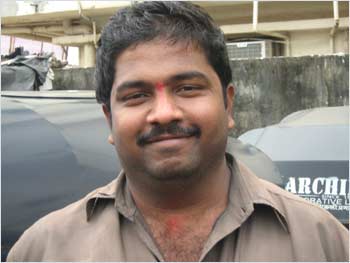 An autorickshaw driver who gives free rides to the blind, donates money to an old age home and is trying to raise funds for the treatment of a sandwich vendor.
 Sandeep Bachhe is an autorickshaw driver in Mumbai. More of him later, but first let me take you through his wonder autorickshaw. It has a television set tuned to good old Doordarshan -- which incidentally is celebrating 50 years of transmission in India. Then there is also a board with the day's price of gold, silver, dollar, pound and the yen.
Behind the driver's seat hangs another chart with phone numbers of hospitals, theatres, hotels and airlines. You can also pick up the day's papers and a couple of magazines in the rack behind him. 'Do not spit,' another notice admonishes you. There are pictures of Gods from all major religions. "All are welcome," he says with a smile.
Of course, you can't have it all, even Bacche's wonder auto has some limitations -- 'No toilet available,' says another sign and Sandeep, 35, explains, "Some college girls got in and told me, 'You have everything where is the toilet?' and so I put this sign up.
"The signboards continue, and there is one that says, 'Donate for old people' with his mobile number below. Sandeep gives whatever he can spare to an old age home. He also collects money from like minded auto drivers to distribute notebooks among slum children.
He points out four other auto drivers to me who had each given Rs 500 the week before to distribute books to needy children.Sandeep also gives free rides of up to Rs 50 to people who are blind and gives a 25 per cent discount to the physically challenged. He gets a physically disabled customer about once a month.
Full Article-
http://news.rediff.com/slide-show/2009/sep/17/slide-show-1-extraordinary-indians-sandeep-bacche.htm
 Part 1- Why has history forgotten this giant?
Kuldip Nayar was Lal Bahadur Shastri's press advisor from 1960 to 1964 and travelled with him extensively. He provides an insight into the former prime minister's life.
Shastri and the Congress-
Shastri has been forgotten by the nation. He has been pushed into the background. I have no doubt that there was a Congress conspiracy to underplay Shastri after his death.
The Congress is the party that should have put him to the fore but I remember visiting a Congress meeting where Shastri's portrait was not even displayed with respect.
He simply didn't fit in. Mrs Gandhi was strongly against the Congress old guard. When he died there was a strong resistance against his cremation in the area where Gandhi and Nehru had been laid to rest. Most Congressmen wanted his body taken to Allahabad. When Mrs Lalita Shastri said she would go public only then did the Congressmen relent.
They even protested against inscribing the slogan -- Jai Jawan, Jai Kisan on his samadhi. Then again, only when Mrs Shastri threatened to go on a hunger strike was it was allowed.
After leaving the Press Information Bureau I became a reporter. Wherever I went to meet Congress leaders, I was labelled as 'Shastri ka aadmi' [Shastri's man].
Now, a committee has been set up by the Congress-led government to celebrate his birth centenary but it seems like an afterthought. I think after the death of Shastri, the Congress did not know where to fit him. When Mrs Gandhi succeeded him, the Congress didn't know where to put his legacy in the scheme of things then.
Shastri stands for austerity.
Shastri stands for simplicity and consensus.
Shastri represents an ideology that was right of Centre but not left of Centre. After all, he is the man who said we need the five-year plan but let us have a one year holiday from plan.
I remember vividly a small incident that brought out the stark difference between the two (Shastri and Indira Gandhi) leaders.
During Shastri's tenure his home in Janpath was upgraded quite a bit to suit the status of a PM.
After his death, while searching for a suitable home Mrs Gandhi went to see Shastri's home. She entered the home, had a round inside and said, "middle class!"
The making of Shastri-
Shastri was selected by veteran Congress leaders K Kamaraj, Neelam Sanjeeva Reddy and S Nijalingappa to lead the nation. Moments after Nehru's death I asked him who should become PM, he said it should be the unanimous decision of the Congress.
He gave two names in order. First, Jayaprakash Narayan and second, Indira Gandhi. He told me he wanted a unanimous decision over the selection. "But if there is a contest (which Morarji Desai contemplated) then I can defeat Morarji Desai but not Indira Gandhi," he told me.
Probably he was right. However, the question didn't arise because Kamaraj was asked to talk to members informally. Shastri was made PM but Morarjibhai never accepted the decision.
After Shastri became PM he had to face the war with Pakistan. When the Chamb border was attacked Shastri was asked to take a tough decision whether to cross the international border. The army chief said it would be difficult to hold on for long at Chamb. Shastri gave the order saying -- before they can capture Chamb you should capture Lahore.
After the war was over, I asked Indira Gandhi if Nehru would have allowed the crossing of the international border. Mrs Gandhi said, 'Whatever the generals would have advised him he would have followed."
But I wonder.
A slight man made of steel-
After the war, Shastri's name was all over. Before the war many people laughed at him for his softness but not after the war. He came out as a tough hero.
His toughness was evident at Tashkent. When Russian Prime Minister Alexei Kosygin wanted Shastri to sign the agreement for peace with General Ayub Khan of Pakistan after the 1965 war, Shastri insisted on adding the assurance, "never again will weapons be used to sort out problems between India and Pakistan."
Ayub was maintaining a vague stance by quoting UN resolutions. "Then you will have to find another PM," said Shastri during the arguments. In the final agreement General Ayub Khan had not mentioned those words but Shastri continued to press for it.
Ayub finally wrote it at the very last moment. General Ayub's handwritten assurance is still preserved in the Indian archives. Shastri was a slight person but with a strong mind.
Also read: Kuldip Nayar on the Tashkent summit
Shastri can't be revived-
If the Congress wants to celebrate Shastri, it will have to re-emphasis the honesty of Shastri. He stood for the small men of India.
But the Congress has changed completely. Since Mrs Gandhi said that corruption is a world phenomenon, Congressmen are not losing sleep over it. Neither can I imagine Shastri imposing the Emergency.
All those Congressmen seen active during the Emergency are part of this government. Ambika Soni is a confidante of Sonia Gandhi, Pranab Mukherjee, Arjun Singh, Kamal Nath all were part of the establishment then.
How can these leaders bring in the values of Shastri?
The Nehru-Gandhi dynasty culture has also played a role in minimising Shastri's legacy. When Shastri was made a minister without portfolio in the Nehru's Cabinet, he was uncomfortable. Once in a huff he told me, "I shall quit and retire to Allahabad."
While cajoling him not to entertain an such idea I said, "Nehru has you in his mind."
Shastri said, "Unke dimag main to unki putri hai. (He has his daughter in his mind as successor.)"
As soon as Shastri died the dynasty culture returned to the Congress. Shastri's message of life was that if he could become PM anybody could because he was a common man. As the Bible says the meekest shall inherit the earth, he proved it.
In 1942 (during the Quit India Movement), when he was in a jail, his daughter was ill and he was released on parole. But he could not save her life because doctors had recommended costly drugs.
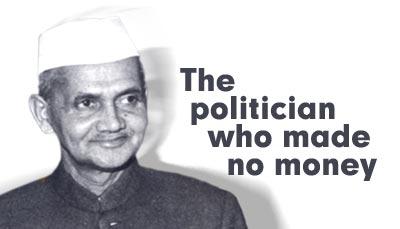
Shastri never made money. In 1963, on the day when he was dropped under the Kamaraj plan I went to meet him. He was sitting in his home without a light.
"Why are you sitting in the dark?" I asked. He said, "From today all expenses will be borne by me." He told me as a MP and minister he didn't earn enough to save for his rainy day.
On that evening, I told him to turn a columnist to earn some money. So he wrote a column on Lala Lajpat Rai. That was the first syndicated column in India.
I syndicated it to four newspapers and collected Rs 500 from each. Quite a hefty sum!
The second column was on Nehru but before he could write more he was recalled to the Cabinet.
I don't see the revival of the values Shastri stood for.
A day before his first press conference after becoming PM I asked him what will be your message tomorrow?
He said: "I'll tell them that during my tenure there will not be any increase in food price and as PM of India I would ask members of the Planning Commission to have one more column in their charts to show me how many jobs will be created after spending thousands of crores of rupees."
He was a man concerned about the common man of India. Can these values return to this country?
I don't think so.
As told to Senior Editor Sheela Bhatt
Source-
http://www.rediff.com/news/2004/oct/07spec1.htm
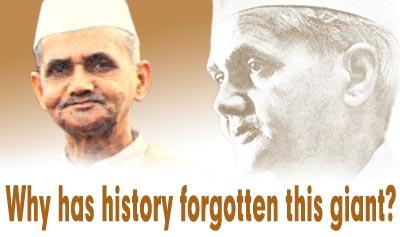
2 days ago India celebrated the birthday of Mahatama Gandhi on 2nd october which is observed as national holiday. Its sad and depressing that more than half of India's population dont know that 2nd october is also the birthday of Lal Bahadur Shastri- 2nd and arguably the best PM of India! So why has history forgotten this giant? Some people know the reason and hope many will soon know it. I had planned to write this post on 2nd October but could not do that because of some work. Anyways here is a great article as tribute from my side on Lal Bahadur Shastri from Rediff. Do read it once and you surely would not regret!
=========================
Seven miles from Kashi in Uttar Pradesh is Mughalsarai. A hundred years ago, Lal Bahadur, India's second prime minister, was born there on October 2, 1904, the same day as India's greatest statesman Mohandas Karamchand Gandhi, born 35 years before Shastriji.
Though his parents Sharada Prasad and Ramdulari Devi were Srivastavas, Shastri dropped his caste identity in his early years. In 1921, inspired by Bal Gangadhar Tilak and Gandhi, he cut short his studies to join India's freedom movement.
Later he joined the Kashi Vidyapeeth and earned the epithet 'Shastri' by obtaining a degree on philosophy.
He won the hearts of Indians when he showed exemplary courage in taking quick decisions as prime minister June 1964 to January 1966) during the India-Pakistan war in 1965. His leadership in war was an answer to that most often asked question at that time: 'After Nehru, who?'
But his untimely death on January 10, 1966 in Tashkent, in suspicious circumstances, deprived him the chance for history to sit in judgement.
In a haphazardly taken decision, the central government has formed a committee to celebrate Shastri's life and work in the year of his centenary.
In an ongoing series rediff.com salutes the 'gentle giant' who led India through the critical years after succeeding Nehru.
Has the nation forgotten Shastri? Is Shastri, who epitomised honesty and sincerity in public life, relevant today?
Anil Shastri, one of the late prime minister's six children and member of the Congress party, recounts memories of his father in a conversation with Senior Editor Sheela Bhatt.
On the Congress treatment of Shastri-
I don't think India has forgotten Lal Bahadur Shastri. Whatever he did is remembered even today. I must say since Sonia Gandhi has taken charge Shastriji's portraits are displayed in all the annual sessions of the party.
Many people have observed that there was a conspiracy to underplay Shastri's legacy within the Congress. This serious charge is untrue for the simple reason that due to his untimely death his contribution to the nation was confined to those 18 to 19 months when he was PM.
Nehru ruled the country for 17 years, Indira Gandhi for 16 years and Rajiv Gandhi for 5 years. Obviously the Nehru-Gandhi contribution is unparalleled because nobody got this opportunity. And remember Shastriji considered him as a protégé of Pandit Nehru. He was never outside the sphere of the Nehru ideology which is the Congress ideology.
Our nation is going to celebrate his birth centenary throughout the year. The committee is formed under the chairmanship of Prime Minister Manmohan Singh.
Even in Tashkent, Uzbekistan, celebrations have been organised on a big scale. E Ahmed, minister of state for external affairs, was in Tashkent to participate in the celebrations.
Shastriji who represented a certain value system is more relevant today than before because a majority of us today have no value systems. I feel difficult to contest elections. I feel a little out of place but for my lineage I have survived in politics.
His father-
I still miss him although I was just 16 years old when he died. If he would have lived 10 more years he would have done much more for the country.
He was down to earth. A real son of the soil. His grounding was from the grassroots level. He was a practical man too. He strongly believed the laws of the land should be changed because the British formed them to rule over India.
He did make an attempt by constituting the administrative reforms commission and made Morarji Desai its chairman. But after he died the idea was shelved.
The most cherished memory I have is the verses of Guru Nanak, which were displayed on his table. As Nehru kept Robert Frost's lines -- 'Miles to go before I sleep', on his desk, my father kept Nanak's quotes in Gurmukhi.
When translated into English they mean -- 'O Nanak! Be tiny like the grass, for other plants will whither away, but grass will remain ever green.'
When under the PL 480 programme, America was going to send inferior quality of wheat to India, he opposed it. He asked the nation to go hungry once a day than accept poor quality food from US.
Before making this announcement he asked my mother not to cook evening meals. He himself followed what he recommended.
The 1965 war with Pakistan-
He appeared very modest but was a man of steel. He had the ability to take quick decisions. It was demonstrated on August 31, 1965. On that day he came home for an early dinner. One of his secretaries told him that the three chiefs of the defence services had come to see him. He immediately left for his office next door at 10, Janpath.
The three chiefs visited him to inform him that the Pakistan army had crossed the international border with 100 battle tanks in the Chamb sector of Jammu. They told him that in a short span of time the Pakistan army would cut off Kashmir from the rest of India.
Without losing time he asked for the opening of a new front including Lahore. Retaliate with full force, he said. What I remember is that the historic meeting lasted less than five minutes. Arjan Singh, the then chief of the air force was present. He is the only surviving member from that meeting.
He told them, "Be prepared for war." He called Defence Minister Y B Chavan and informed him of the decision. He responded positively and expressed his support. He didn't wait for international reactions. The next day, newspapers reported that the Indian army was marching towards Lahore. It was a big morale booster for the country.
During those tense days, in his address to the nation from Red Fort on Independence day, he said: "Hathiyaron ka jawab hathiyaron se denge. (Force will be met with force.) Hamara desh rahega to hamara tiranga rahega. (Our flag will survive only if our country does)"
On Shastri and the Nehru-Gandhi family-
Pandit Nehru was very found of him. Shastriji was around 15 years younger but he trusted him fully.
In 1956, when a train accident killed 144 passengers near Ariyalur in Tamil Nadu, Shastriji resigned. Panditji refused to accept the resignation but he prevailed upon Panditji to accept it.
On the following day in Parliament, Nehru said no one could wish for a better comrade than Lal Bahadur. A man of the highest integrity and devoted to ideas is called Lal Bahadur, said Nehru.
Once he was sent to Kashmir by Nehru to help resolve the theft in the Hazaratbal shrine. Nehru asked him whether he had enough woollens for the trip.
"Are you aware Kashmir must be having snowfall at this time?" asked Nehru.
Shastri showed him the jacket he was wearing and Nehru immediately gave his own mink overcoat.
My father was short in stature so he told Nehru the coat was quite long. But Nehru said woollen overcoats were always longer. That no one would know it was a borrowed one.
On his return from Kashmir when father went to him to return the overcoat, Nehru asked him to keep it. The next day newspapers reported: Nehru's Mantle Falls on Shastri.
Shastriji and Indiraji also enjoyed a close relationship. She had the highest personal regard for him. After Nehru's death in 1964, the Congress chose him as a consensus candidate. He did make an attempt to persuade Indira Gandhi to take over as prime minister. He went to see her and asked her to become prime minister.
She put her foot down and said no. "You become PM and I'll totally support you," she said. When he was PM he would drop by at 1, Safdarjung Road (Indira Gandhi's home) without intimation just to chat with her.
Part 2- The politician who made no money
Source-
http://in.rediff.com/news/2004/oct/06spec1.htm