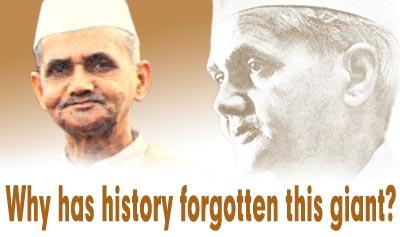
In the below video 1 Pakistani news anchor talks about the 2nd and Best Prime Minister of India. Its a shame that Indians know very less about him because there has been a serious effort to downplay his role in Indian history and there has been hardly any program on Indian news channels covering Lal Bahadur Shastri and his legacy.
Read here
_________________________________________
How there was a conspiracy to downplay his role after his suspicious death-
Read here
_________________________________________
A comparison between possibly the strongest and the weakest Prime minister-
Read here

Seeing the general people these days specially the youth and the younsters its not uncommon to worry about the future of Mankind. Every generation has done it.
While one regularly sees people's apathy towards other human beings while they are busy in drugs,dopes, street crimes, making fun of themselves just to appear on TV (MTV, V TV, Bindaas fame people) etc thankfully there are many people who are working tirelessly helping others around the world. Whats more surprising is that they are kids making the point that age is not a factor if one has a will to do something. Also make us question ourselves- What have we done in our life till now?
Abby Miller is a 12-year-old musician who collects donations for 4-year-old Taylor Love, who suffers from neuroblastoma, a form of cancer affecting the nervous system. Most contributions come the old fashioned way– from playing on the street with a contribution bucket nearby. All funds go to help Taylor’s family with medical expenses. Passersby typically note Abby’s talent and drop in a few bucks, wondering why a young kid would be singing in the street on a cold day. Few notice she’s singing for a cause greater than herself.
Olivia Bouler is an 11-year-old artist who has raised over $200,000 for the National Audubon Society, which is hard at work rescuing birds affected by the BP oil spill in the Gulf of Mexico.
It all started when Olivia saw the oil spill on TV. Not knowing how to help, she wrote a letter to the Audubon Society, offering to sell her illustrations to raise money for cleanup costs. Then she hit upon the idea of just giving her drawings to anyone who donated to wildlife recovery efforts. Media outlets caught wind of her offer and the donations came flooding in. She’s made 150 illustrations so far, and shows no signs of stopping.
8.) Cameron Cohen
Cameron Cohen was 11-years old when he was stuck at home with a hip-to-toe brace following bone tumor surgery. Instead of playing Halo or watching Spongebob, Cameron spent his downtime learning software development. He then used his mad skillz to design ‘iSketch’, a drawing program now available on the iPhone App Store. Cameron donates a portion of his earnings to purchase electronic and entertainment items for other pre-teens to enjoy during their hospitalization.
7.) Jordan Somer

Jordan Somer is a Nebraska teen who founded the “Miss Amazing” pageant, an event for girls and women coping with physical and mental disabilities. The event focuses on all participants gaining confidence and revealing their true beauty. Jordan started the event in 2006, as a way to combine her own pageant experience with her Special Olympics volunteer work. Jordan recently received Teen Nickelodeon’s Halo Award, and hopes to use the $25,000 grant to expand the pageant nationally.
5-year-old Phoebe Russell needed to complete a community service project before she could graduate from kindergarten. Uninterested in a lemonade stand, she saw a homeless man begging for food and decided to raise $1,000 for the San Francisco Food Bank. Her teacher tried to lower expectations to something more reasonable, but Phoebe’s heartwarming appeal to leave soda cans and donations at the school snowballed. Before she knew it, Phoebe had raised $3,736.30– the equivalent of 17,800 heated meals.
Brittany and Robbie Bergquist (12 and 13, respectively) learned of a soldier who racked up an $8000 cell phone bill by calling his family from Iraq. They decided to pay the soldier’s phone bill and brought $21 to the bank to start an account. The bank manager was so impressed he added an additional $500. This encouraged them to keep trying.
The kids then held car washes and bake sales, but then decided on recycling used cell phones. With help from volunteers, they set up drop-off sites across the USA, and used the proceeds to buy prepaid phone cards for troops overseas. To date their ‘Cell Phones for Soldiers” program has collected 7.5 million phones and provided military personnel with over 90 million minutes’ worth of pre-paid airtime.
Mackenzie Bearup is a 16-year-old girl with Reflex Sympathetic Dystrophy, a medical condition that makes cold weather, wind and vibrations excruciatingly painful. She found relief in books, and reads constantly. Then she learned of a residential treatment center that needed books for its library, and began soliciting donations. Mackenzie’s book drives have since donated over 50,000 books to treatment centers in Georgia and neighboring states, and Nestle gave her their 2009 ‘Best in Youth’ award.
Her altruism appears to be a good tonic as well: since starting her volunteer work, Mackenzie has maintained a 4.0 GPA in gifted and talented classes. She also plays harp in an orchestra, and has performed at charity events, assisted living facilities, and nursing homes.
In 2007, Timothy Hwang and Minsoo Han started Operation Fly, when they were only 14 years old. Their non-profit business offers cut-rate tutoring services to inner city students, and then uses the revenues to distribute blankets, clothing and soap to Washington DC’s homeless. Their organization has since spread to five cities, involves over 800 volunteers and is entirely student-run. For his efforts, Ernst & Young and Junior Achievement named Timothy Hwang the 2009 Youth Entrepreneur of the Year for the Greater Washington Region.
After hurricane Charlie hit Florida in 2005, Zach Bonner collected water bottles in his neighborhood using a little red wagon. By the end of the charity drive, he had 27 truckloads of aid. And he was just getting started.
In 2007, Zach began a three-stage “My House to the White House” charity march, to raise money for homeless children. In Stage 1, he walked 280 miles from Tampa to Tallahassee, Florida. In stage 2, he walked 250 miles from Tallahassee to Atlanta, Georgia. In the last leg of the trip, he walked 668 miles from Atlanta to Washington, DC. His most serious test came when his grandmother died, and the 11-year-old was forced to choose between finishing the walk or attending her funeral. He continued the trek and dedicated the march in her honor. All monies were split between a playground for an emergency foster care shelter in Tampa, and the Sasha Bruce Youthwork, which helps runaways and homeless kids in Washington, DC.
In 2010 Zach’s ‘March Across America” took him 2,448 miles from Tampa to Los Angeles, culminating in a meeting with Elton John, who contributed $25,000 to the Little Red Wagon Foundation.
Harry Moseley is a nine-year-old from Sheldon, Birmingham, UK. He lives with an inoperable brain tumor, but this hasn’t stopped him from making and selling beaded bracelets for Brain Tumour UK. His bracelets are now available in over 30 shops across Britain, and so far he’s raised over £15,000.
Harry also gives PowerPoint presentations to school kids, and encourages them to set up bracelet making clubs. Harry’s system gives 15p from every bracelet sold to the kids’ school and the rest goes to Brain Tumour UK. Harry started his fundraising efforts after an elderly friend in the hospital bed next to him died from their shared condition.
When presented with the 2010 ‘Britain’s Kindest Kid’ award, reports say Harry was “speechless” and “gobsmacked”. He plans to give £200 each to his brother and sister and spend the rest on a wooden playhouse in the garden where he can make bracelets. He dedicated his prize to his late friend Robert Harley.

Someday a better writer will make a new list of young philanthropists, and I wouldn’t be surprised if the kids on it were involved with the Be Better U Dream Ranch, which helps children learn and teach other kids about philanthropy. If you or your child are in the Dallas-Fort Worth area, and are interested in child-led philanthropy programs, go to their website and see if you’d like to help out.
PS: All names are strictly in Random order.
Via LISTVERSE
 If you had not heard of Narayanan Krishnan, as I had not, it is a collective failure. This is one of the most incredible stories of personal commitment.
Narayanan Krishnan, all of 29 years old now, does what he was professionally trained to do as a chef. Feed people. Only Krishnan does not do this in the swanky confines of a 5-star hotel. Every day, he wakes up at 4 am, cooks a simple hot meal and then, along with his team, loads it in a van and travels about 200 km feeding the homeless in Madurai, Tamil Nadu.
Krishnan feeds, often with his hands, almost 400 destitute people every day. And for those who need it, he provides a free haircut too.
According to CNN, eight years ago, this award-winning chef with a five-star hotel chain was all set to go to Switzerland for a high-profile posting. On a visit to a Madurai temple, he came across a homeless, old man eating his own human waste. That stark sight changed Krishnan's life.
Much to the dismay of his parents, CNN says, Krishnan abandoned his career plans and decided to spend his life and his professional training in looking after those who could not care for themselves. He has provided more than 1.2 million hot meals through his nonprofit organisation Akshaya Trust, and now hopes to extend this to shelter for the homeless too.
Krishnan is the only Indian in a list of 10 heroes that CNN has picked worldwide to honour. One of them will be chosen CNN Hero of the Year, selected by the public through an online poll. If many Indians get together to vote for this inspiring man, he can win by a long mile.
If Krishnan wins he will get $100,000 in addition to the $25,000 that he gets for being shortlisted for the Top 10. Akshaya Trust needs all the monetary support it can get to build on Krishnan's dream. Let's help him get there.
 Many times people may have come across situations where they saw something wrong happening but couldn't do anything because the enemy was too strong or had better weapons. But the incident mentioned below shows that sometimes its intent and inner strength what matters instead of power or weapons. Hats off to Salim Ahmed because what he did many others wouldn't have done!
Rs 25k reward for rickshawpuller
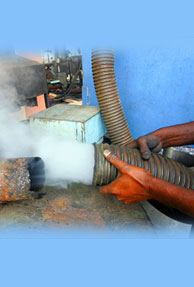 Mumbai: Many villages in Bihar has literally lifted out of darkness with an uninterrupted, self-sufficient power supply, thanks to Gyanesh Pandey, the promoter of Husk Power Systems that transforms piles of discarded rice husk to light up the villages, reports Manu A B from Rediff Business. Now, around 50,000 villagers in 120 villages across Bihar and 3 villages in Uttar Pradesh have been benefited by these 'green' power plants.
 After resigning his job in U.S., Gyanesh returned to his native home state in 2007 and he teamed up with his friends Ratnesh Yadav, Manoj Sinha and Charles W Ransler to set up Husk Power Systems. Their idea was to provide power to villagers who depended on agriculture as their main occupation in a cost-effective and environmentally-friendly manner. After research and experiments, the team decided that the most feasible way would be making electricity from rice husk. Today HPS owns and operates 40 mini-power plants (35-100 kw) across Bihar. Through this unique green technology, villages get uninterrupted power for up to 6-12 hours by setting up a plant, which burns rice husk to generate gas to run generators.
For villagers, this cheap and eco-friendly model of generating electricity is a miracle that has transformed their lives. "After 60 years of independence, we got the real azadi (freedom) now," Rambalak Yadav, an excited school teacher from Tamkuha, said.
"Becoming an entrepreneur was an evolutionary process. I had a good life in America. I did not face any problems there, but I always had the feeling that I must do something for our villages. I do not feel I have made any sacrifice. Today, there is hardly anything I do other than work. It gives me the satisfaction no job can ever give," says Gyanesh, who feels India's acute power crisis must be solved efficiently with renewable resources.
The company is set to make profits by the end of this year and plans to light up villages in other states like Maharastra, West Bengal, Uttar Pradesh and Tamil Nadu.
Providing electricity to villages across India is just the beginning of Gyanesh's ambitious plan to transform rural India. The company has already taken up the initiative to educate 200 children from Tumkuha.
Link

See the below video to find out what YOU, ME and the COMMON MAN can do for the enivronment. Very simple, very powerful and very Inspirational. Must see!

Fame is something that descends on people who show exceptional qualities in their deeds and words. But, it really needs much more for a person to find a place in the hearts of millions of people and at the same time, keep his feet on the ground. Avul Pakir Jainulabdeen Abdul Kalam, whom we fondly call APJ Abdul Kalam, is such a man who touches the lives of millions people with his charismatic persona. He is not just an Ex-President of India or the undisputed father of Indian missile technology; he is perhaps the only Indian who stands closest to Gandhiji, the father of our nation, for whom ideals and actions never ran in parallel lines.
Son of the soil
Abdul Kalam was born on 15 October 1931 at Dhanushkodi in the Rameswaram district of Tamil Nadu. He was neither educated abroad, nor was his family financially very strong to support his academic pursuits. His father, Jainulabiddin Marakayar, had to rent boats out to fishermen to pay for his school fees. His father possessed great innate wisdom, true generosity of spirit and was a spiritual person.
Kalam received secondary education at the Schwartz School, a missionary institute in Ramanathapuram, and later joined the St Joseph's College at Tiruchirrapalli, where he graduated with a Bachelor in Science. Abdul Kalam went on to study Aeronautical Engineering at the Madras Institute of Technology.
He was the first graduate in the family. His brothers did not even finish their school studies. He distributed newspapers at a young age to help with household expenses.
An Indian to the core, the only brief overseas exposure that he got during his formative years was in 1963-64 when he was invited by NASA (National Aeronautics and Space Administration) to spend four months in the United States at the Wallops Island Rocketry Centre and the Langley Research Centre.
A vegetarian, a teetotaller and a confirmed bachelor, Abdul Kalam recites the Quran and the Bhagvad Gita with equal ease.
`Flying’ dreams and disillusionment
After completing his third year at MIT, Kalam joined Hindustan Aeronautics Limited (HAL), Bangalore as a trainee. When he came out of HAL as a graduate of aeronautical engineering in 1958, he was eager to join Indian Air Force as a pilot. The other alternative was to seek a job at Directorate of Technical Development and Production (DTD&P) of the Ministry of Defence. He applied for both and attended interviews. He stood ninth in the batch of 25 in IAF, and only eight officers were selected to be commissioned in the Air Force. He felt the long cherished dream slipping away from his hands.
Disillusioned, Kalam visited Hrishikesh, bathed in the Ganga and met Swami Sivananda whom he later remembered as “a man who looked like Buddha". According to his own personal accounts, Sivananda asked Kalam about the reason for his sorrow. Kalam told him about his unsuccessful attempt to join the IAF and his long-cherished desire to fly. Sivananda guided him saying: "Accept your destiny and go ahead with your life. You are not destined to become an Air Force pilot. What you are destined to become is not revealed now but it is predetermined. Forget this failure, as it was essential to lead you to your destined path. Search, instead, for the true purpose of your existence. Become one with yourself, my son! Surrender yourself to the wish of God." Back from Hrishikesh, Kalam received appointment letter from DTD&T and joined the organisation as a senior scientific assistant. There he led a small team that developed a prototype hovercraft.
Tryst with space science
In 1962, Kalam moved out of DRDO and joined Indian Space Research Organization (ISRO) where he succeeded in putting the 35-kg Rohini-I satellite on a low-earth orbit with help of the SLV-III (Satellite Launch Vehicle). After spending 19 fruitful years in ISRO, he returned to DRDO in 1982 to head the country's Integrated Missile Development Programme, which culminated in the successful launch of the Agni, Prithvi, Akash, Trishul and Nag missiles.
Dr. Kalam was Scientific Advisor to the Defence Minister & Secretary, Department of Defence Research & Development from July 1992 to December 1999. He was Chief Scientific Advisor to the Govt of India till he demitted office in November 2001.
Dr. Kalam is one of the most distinguished scientists of India with the unique honour of receiving honorary doctorates from 30 universities and institutions. He has been awarded the coveted civilian awards - Padma Bhushan (1981) and Padma Vibhushan (1990) and the highest civilian award Bharat Ratna (1997). He is a recipient of several other awards and Fellow of many professional institutions.
People’s President
Dr. Kalam became the 11th President of India on 25th July 2002, with a focus to transform India into a developed nation by 2020.
During his term as President of the national, Abdul Kalam earned the respect and love of people and was often referred to as the People’s President. Throughout his Presidential term, Kalam made it a point to inspire the young minds and prompt the young generations to dream big to achieve bigger goals for the nation.
Kalam visualised a glorious profile of India to emerge by the year 2020. Its details are as follows:
1. A nation where the rural and urban divide is reduced to the minimum.
2. A nation where there is an equitable distribution and adequate access to energy and quality water.
3. A nation where agriculture, industry and service sector work together in symphony.
4. A nation where education with value system is not denied to any meritorious candidates because of societal or economic discrimination.
5. A nation which is the best destination for the most talented scholars, scientists, and investors.
6. A nation where the best of health care is available to all.
7. A nation where the governance is responsive and transparent.
8. A nation where poverty has been totally eradicated, illiteracy removed and crimes against women and children are absent and none in the society feels alienated.
9. A nation that is prosperous, healthy, secure, peaceful and happy and continues in a sustainable growth path.
10. A nation that is one of the best places to live in and is proud of its leadership.
When he was interacting with a group of journalists, just before he stepped down as the President, he said he was proud of his three achievements as the President of India. One was to make Rashtrapati Bhavan a ``People's Bhavan'' by throwing open its majestic doors to people from all walks of life. The second was to spread and popularise his PURA (Providing Urban Amenities in Rural Areas) concept. And the third was to get acceptability for his Vision 2020 for India.
During that interaction, he also he hinted at his distress over reports that he had sought a second term. He clarified that he had always maintained that he would accept another term only if there was consensus on his name. (The only party that opposed to his candidature was the Congress and have a look at the Congress choice HERE and HERE.) He said that he had never talked about numbers.
Man of composure
As we prepare this tribute to Abdul Kalam, controversy is raging over an incident in which former President Kalam was frisked by the staff of America’s Continental Airlines. 77-year-old Kalam was frisked in violation of the mandatory protocol at Delhi International airport before he was to board the Newark-bound Continental Airline flight on April 21.
The issue came up in the Parliament and the airlines tendered apology over the incident. However, kalam refused to give up his composure. “Whatever is reported is true. However, I have no complaints against anybody,” he was quoted as saying, when asked about the incident.
MSN link
 About this talk-
Traditionally, the Kalandar community of India has survived by capturing sloth bear cubs and training them to "dance" through extreme cruelty. Kartick Satyanarayan has been able to put an end to this centuries-old practice, and in so doing discovered a lesson of wider significance: make the practitioners part of the solution.
About Kartick Satyanarayan-
Kartick Satyanran works tirelessly to save India’s wild animals from illegal captivity and poaching -- most notably rescuing hundreds of “dancing” bears.
 About this talk-
Kiran Bir Sethi shows how her groundbreaking Riverside School in India teaches kids life's most valuable lesson: "I can." Watch her students take local issues into their own hands, lead other young people, even educate their parents.
About Kiran Sethi-
The founder of the Riverside School in Ahmedabad, Kiran Sethi has launched an initiative to make our cities more child-friendly.

Around the world millions of children are not getting a proper education because their families are too poor to afford to send them to school. In India, one schoolboy is trying to change that. In the first report in the BBC's Hunger to Learn series, Damian Grammaticas meets Babar Ali, whose remarkable education project is transforming the lives of hundreds of poor children.
At 16 years old, Babar Ali must be the youngest headmaster in the world. He's a teenager who is in charge of teaching hundreds of students in his family's backyard, where he runs classes for poor children from his village.
The story of this young man from Murshidabad in West Bengal is a remarkable tale of the desire to learn amid the direst poverty.
Babar Ali's day starts early. He wakes, pitches in with the household chores, then jumps on an auto-rickshaw which takes him part of the 10km (six mile) ride to the Raj Govinda school. The last couple of kilometres he has to walk.
The school is the best in this part of West Bengal. There are hundreds of students, boys and girls. The classrooms are neat, if bare. But there are desks, chairs, a blackboard, and the teachers are all dedicated and well-qualified.
As the class 12 roll-call is taken, Babar Ali is seated in the middle in the front row. He's a tall, slim, gangly teenager, studious and smart in his blue and white uniform. He takes his notes carefully. He is the model student.
Babar Ali is the first member of his family ever to get a proper education. "It's not easy for me to come to school because I live so far away," he says, "but the teachers are good and I love learning. And my parents believe I must get the best education possible that's why I am here."
Raj Govinda school is government-run so it is free, all Babar Ali has to pay for is his uniform, his books and the rickshaw ride to get there. But still that means his family has to find around 1,800 rupees a year ($40, £25) to send him to school. In this part of West Bengal that is a lot of money. Many poor families simply can't afford to send their children to school, even when it is free.
Chumki Hajra is one who has never been to school. She is 14 years old and lives in a tiny shack with her grandmother. Their home is simple A-frame supporting a thatched roof next to the rice paddies and coconut palms at the edge of the village. Inside the hut there is just room for a bed and a few possessions.
Every morning, instead of going to school, she scrubs the dishes and cleans the homes of her neighbours. She's done this ever since she was five. For her work she earns just 200 rupees a month ($5, £3). It's not much, but it's money her family desperately needs. And it means that she has to work as a servant everyday in the village.
"My father is handicapped and can't work," Chumki tells me as she scrubs a pot. "We need the money. If I don't work, we can't survive as a family. So I have no choice but to do this job."
But Chumki is now getting an education, thanks to Babar Ali. The 16-year-old has made it his mission to help Chumki and hundreds of other poor children in his village. The minute his lessons are over at Raj Govinda school, Babar Ali doesn't stop to play, he heads off to share what he's learnt with other children from his village.
At four o'clock every afternoon after Babar Ali gets back to his family home a bell summons children to his house. They flood through the gate into the yard behind his house, where Babar Ali now acts as headmaster of his own, unofficial school.
Lined up in his back yard the children sing the national anthem. Standing on a podium, Babar Ali lectures them about discipline, then study begins.
Babar Ali gives lessons just the way he has heard them from his teachers. Some children are seated in the mud, others on rickety benches under a rough, homemade shelter. The family chickens scratch around nearby. In every corner of the yard are groups of children studying hard.
Babar Ali was just nine when he began teaching a few friends as a game. They were all eager to know what he learnt in school every morning and he liked playing at being their teacher.
Now his afternoon school has 800 students, all from poor families, all taught for free. Most of the girls come here after working, like Chumki, as domestic helps in the village, and the boys after they have finished their day's work labouring in the fields.
"In the beginning I was just play-acting, teaching my friends," Babar Ali says, "but then I realised these children will never learn to read and write if they don't have proper lessons. It's my duty to educate them, to help our country build a better future."
Including Babar Ali there are now 10 teachers at the school, all, like him are students at school or college, who give their time voluntarily. Babar Ali doesn't charge for anything, even books and food are given free, funded by donations. It means even the poorest can come here.
"Our area is economically deprived," he says. "Without this school many kids wouldn't get an education, they'd never even be literate."
Seated on a rough bench squeezed in with about a dozen other girls, Chumki Hajra is busy scribbling notes.
Her dedication to learning is incredible to see. Every day she works in homes in the village from six in the morning until half past two in the afternoon, then she heads to Babar Ali's school. At seven every evening she heads back to do more cleaning work.
Chumki's dream is to one day become a nurse, and Babar Ali's classes might just make it possible.
The school has been recognised by the local authorities, it has helped increase literacy rates in the area, and Babar Ali has won awards for his work.
The youngest children are just four or five, and they are all squeezed in to a tiny veranda. There are just a couple of bare electric bulbs to give light as lessons stretch into the evening, and only if there is electricity.
And then the monsoon rain begins. Huge drops fall as the children scurry for cover, slipping in the mud. They crowd under a piece of plastic sheeting. Babar Ali shouts an order. Lessons are cancelled for the afternoon otherwise everyone will be soaked. Having no classrooms means lessons are at the mercy of the elements.
The children climb onto the porch of a nearby shop as the rain pours down. Then they hurry home through the downpour. Tomorrow they'll be back though. Eight hundred poor children, unable to afford an education, but hungry for anything they can learn at Babar Ali's school.
A great article from BBC. Do check out the original thread to see the video of Babar's school, Interview of 1 of the student and Babar answering questions of students from various parts of world!! Truly remarkable!!
Link-
A VERY VERY INTERESTING READ. RECOMMENDED
Article-
http://search.rediff.com/news/2003/feb/01spec.htm
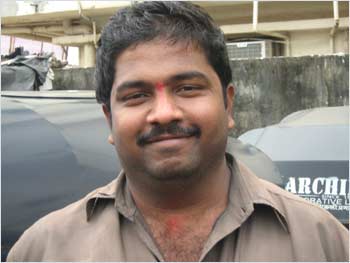 An autorickshaw driver who gives free rides to the blind, donates money to an old age home and is trying to raise funds for the treatment of a sandwich vendor.
 Sandeep Bachhe is an autorickshaw driver in Mumbai. More of him later, but first let me take you through his wonder autorickshaw. It has a television set tuned to good old Doordarshan -- which incidentally is celebrating 50 years of transmission in India. Then there is also a board with the day's price of gold, silver, dollar, pound and the yen.
Behind the driver's seat hangs another chart with phone numbers of hospitals, theatres, hotels and airlines. You can also pick up the day's papers and a couple of magazines in the rack behind him. 'Do not spit,' another notice admonishes you. There are pictures of Gods from all major religions. "All are welcome," he says with a smile.
Of course, you can't have it all, even Bacche's wonder auto has some limitations -- 'No toilet available,' says another sign and Sandeep, 35, explains, "Some college girls got in and told me, 'You have everything where is the toilet?' and so I put this sign up.
"The signboards continue, and there is one that says, 'Donate for old people' with his mobile number below. Sandeep gives whatever he can spare to an old age home. He also collects money from like minded auto drivers to distribute notebooks among slum children.
He points out four other auto drivers to me who had each given Rs 500 the week before to distribute books to needy children.Sandeep also gives free rides of up to Rs 50 to people who are blind and gives a 25 per cent discount to the physically challenged. He gets a physically disabled customer about once a month.
Full Article-
http://news.rediff.com/slide-show/2009/sep/17/slide-show-1-extraordinary-indians-sandeep-bacche.htm
 Shocked by the nature's fury in Karnataka and the apathy shown by Central govt which gave just Rs 50 crore for flood relief Karnataka CM B S Yeddyurappa took it upon himself to collect money to provide relief to those affected. He was able to collect Rs 500 crore in just 48 hours for flood relief by taking a Padayatra.
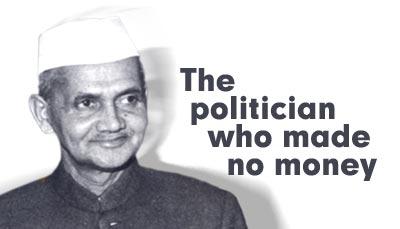 Part 1- Why has history forgotten this giant?
Kuldip Nayar was Lal Bahadur Shastri's press advisor from 1960 to 1964 and travelled with him extensively. He provides an insight into the former prime minister's life.
Shastri and the Congress-
Shastri has been forgotten by the nation. He has been pushed into the background. I have no doubt that there was a Congress conspiracy to underplay Shastri after his death.
The Congress is the party that should have put him to the fore but I remember visiting a Congress meeting where Shastri's portrait was not even displayed with respect.
He simply didn't fit in. Mrs Gandhi was strongly against the Congress old guard. When he died there was a strong resistance against his cremation in the area where Gandhi and Nehru had been laid to rest. Most Congressmen wanted his body taken to Allahabad. When Mrs Lalita Shastri said she would go public only then did the Congressmen relent.
They even protested against inscribing the slogan -- Jai Jawan, Jai Kisan on his samadhi. Then again, only when Mrs Shastri threatened to go on a hunger strike was it was allowed.
After leaving the Press Information Bureau I became a reporter. Wherever I went to meet Congress leaders, I was labelled as 'Shastri ka aadmi' [Shastri's man].
Now, a committee has been set up by the Congress-led government to celebrate his birth centenary but it seems like an afterthought. I think after the death of Shastri, the Congress did not know where to fit him. When Mrs Gandhi succeeded him, the Congress didn't know where to put his legacy in the scheme of things then.
Shastri stands for austerity.
Shastri stands for simplicity and consensus.
Shastri represents an ideology that was right of Centre but not left of Centre. After all, he is the man who said we need the five-year plan but let us have a one year holiday from plan.
I remember vividly a small incident that brought out the stark difference between the two (Shastri and Indira Gandhi) leaders.
During Shastri's tenure his home in Janpath was upgraded quite a bit to suit the status of a PM.
After his death, while searching for a suitable home Mrs Gandhi went to see Shastri's home. She entered the home, had a round inside and said, "middle class!"
The making of Shastri-
Shastri was selected by veteran Congress leaders K Kamaraj, Neelam Sanjeeva Reddy and S Nijalingappa to lead the nation. Moments after Nehru's death I asked him who should become PM, he said it should be the unanimous decision of the Congress.
He gave two names in order. First, Jayaprakash Narayan and second, Indira Gandhi. He told me he wanted a unanimous decision over the selection. "But if there is a contest (which Morarji Desai contemplated) then I can defeat Morarji Desai but not Indira Gandhi," he told me.
Probably he was right. However, the question didn't arise because Kamaraj was asked to talk to members informally. Shastri was made PM but Morarjibhai never accepted the decision.
After Shastri became PM he had to face the war with Pakistan. When the Chamb border was attacked Shastri was asked to take a tough decision whether to cross the international border. The army chief said it would be difficult to hold on for long at Chamb. Shastri gave the order saying -- before they can capture Chamb you should capture Lahore.
After the war was over, I asked Indira Gandhi if Nehru would have allowed the crossing of the international border. Mrs Gandhi said, 'Whatever the generals would have advised him he would have followed."
But I wonder.
A slight man made of steel-
After the war, Shastri's name was all over. Before the war many people laughed at him for his softness but not after the war. He came out as a tough hero.
His toughness was evident at Tashkent. When Russian Prime Minister Alexei Kosygin wanted Shastri to sign the agreement for peace with General Ayub Khan of Pakistan after the 1965 war, Shastri insisted on adding the assurance, "never again will weapons be used to sort out problems between India and Pakistan."
Ayub was maintaining a vague stance by quoting UN resolutions. "Then you will have to find another PM," said Shastri during the arguments. In the final agreement General Ayub Khan had not mentioned those words but Shastri continued to press for it.
Ayub finally wrote it at the very last moment. General Ayub's handwritten assurance is still preserved in the Indian archives. Shastri was a slight person but with a strong mind.
Also read: Kuldip Nayar on the Tashkent summit
Shastri can't be revived-
If the Congress wants to celebrate Shastri, it will have to re-emphasis the honesty of Shastri. He stood for the small men of India.
But the Congress has changed completely. Since Mrs Gandhi said that corruption is a world phenomenon, Congressmen are not losing sleep over it. Neither can I imagine Shastri imposing the Emergency.
All those Congressmen seen active during the Emergency are part of this government. Ambika Soni is a confidante of Sonia Gandhi, Pranab Mukherjee, Arjun Singh, Kamal Nath all were part of the establishment then.
How can these leaders bring in the values of Shastri?
The Nehru-Gandhi dynasty culture has also played a role in minimising Shastri's legacy. When Shastri was made a minister without portfolio in the Nehru's Cabinet, he was uncomfortable. Once in a huff he told me, "I shall quit and retire to Allahabad."
While cajoling him not to entertain an such idea I said, "Nehru has you in his mind."
Shastri said, "Unke dimag main to unki putri hai. (He has his daughter in his mind as successor.)"
As soon as Shastri died the dynasty culture returned to the Congress. Shastri's message of life was that if he could become PM anybody could because he was a common man. As the Bible says the meekest shall inherit the earth, he proved it.
In 1942 (during the Quit India Movement), when he was in a jail, his daughter was ill and he was released on parole. But he could not save her life because doctors had recommended costly drugs.
Shastri never made money. In 1963, on the day when he was dropped under the Kamaraj plan I went to meet him. He was sitting in his home without a light.
"Why are you sitting in the dark?" I asked. He said, "From today all expenses will be borne by me." He told me as a MP and minister he didn't earn enough to save for his rainy day.
On that evening, I told him to turn a columnist to earn some money. So he wrote a column on Lala Lajpat Rai. That was the first syndicated column in India.
I syndicated it to four newspapers and collected Rs 500 from each. Quite a hefty sum!
The second column was on Nehru but before he could write more he was recalled to the Cabinet.
I don't see the revival of the values Shastri stood for.
A day before his first press conference after becoming PM I asked him what will be your message tomorrow?
He said: "I'll tell them that during my tenure there will not be any increase in food price and as PM of India I would ask members of the Planning Commission to have one more column in their charts to show me how many jobs will be created after spending thousands of crores of rupees."
He was a man concerned about the common man of India. Can these values return to this country?
I don't think so.
As told to Senior Editor Sheela Bhatt
Source-
http://www.rediff.com/news/2004/oct/07spec1.htm
2 days ago India celebrated the birthday of Mahatama Gandhi on 2nd october which is observed as national holiday. Its sad and depressing that more than half of India's population dont know that 2nd october is also the birthday of Lal Bahadur Shastri- 2nd and arguably the best PM of India! So why has history forgotten this giant? Some people know the reason and hope many will soon know it. I had planned to write this post on 2nd October but could not do that because of some work. Anyways here is a great article as tribute from my side on Lal Bahadur Shastri from Rediff. Do read it once and you surely would not regret!
=========================
Seven miles from Kashi in Uttar Pradesh is Mughalsarai. A hundred years ago, Lal Bahadur, India's second prime minister, was born there on October 2, 1904, the same day as India's greatest statesman Mohandas Karamchand Gandhi, born 35 years before Shastriji.
Though his parents Sharada Prasad and Ramdulari Devi were Srivastavas, Shastri dropped his caste identity in his early years. In 1921, inspired by Bal Gangadhar Tilak and Gandhi, he cut short his studies to join India's freedom movement.
Later he joined the Kashi Vidyapeeth and earned the epithet 'Shastri' by obtaining a degree on philosophy.
He won the hearts of Indians when he showed exemplary courage in taking quick decisions as prime minister June 1964 to January 1966) during the India-Pakistan war in 1965. His leadership in war was an answer to that most often asked question at that time: 'After Nehru, who?'
But his untimely death on January 10, 1966 in Tashkent, in suspicious circumstances, deprived him the chance for history to sit in judgement.
In a haphazardly taken decision, the central government has formed a committee to celebrate Shastri's life and work in the year of his centenary.
In an ongoing series rediff.com salutes the 'gentle giant' who led India through the critical years after succeeding Nehru.
Has the nation forgotten Shastri? Is Shastri, who epitomised honesty and sincerity in public life, relevant today?
Anil Shastri, one of the late prime minister's six children and member of the Congress party, recounts memories of his father in a conversation with Senior Editor Sheela Bhatt.
On the Congress treatment of Shastri-
I don't think India has forgotten Lal Bahadur Shastri. Whatever he did is remembered even today. I must say since Sonia Gandhi has taken charge Shastriji's portraits are displayed in all the annual sessions of the party.
Many people have observed that there was a conspiracy to underplay Shastri's legacy within the Congress. This serious charge is untrue for the simple reason that due to his untimely death his contribution to the nation was confined to those 18 to 19 months when he was PM.
Nehru ruled the country for 17 years, Indira Gandhi for 16 years and Rajiv Gandhi for 5 years. Obviously the Nehru-Gandhi contribution is unparalleled because nobody got this opportunity. And remember Shastriji considered him as a protégé of Pandit Nehru. He was never outside the sphere of the Nehru ideology which is the Congress ideology.
Our nation is going to celebrate his birth centenary throughout the year. The committee is formed under the chairmanship of Prime Minister Manmohan Singh.
Even in Tashkent, Uzbekistan, celebrations have been organised on a big scale. E Ahmed, minister of state for external affairs, was in Tashkent to participate in the celebrations.
Shastriji who represented a certain value system is more relevant today than before because a majority of us today have no value systems. I feel difficult to contest elections. I feel a little out of place but for my lineage I have survived in politics.
His father-
I still miss him although I was just 16 years old when he died. If he would have lived 10 more years he would have done much more for the country.
He was down to earth. A real son of the soil. His grounding was from the grassroots level. He was a practical man too. He strongly believed the laws of the land should be changed because the British formed them to rule over India.
He did make an attempt by constituting the administrative reforms commission and made Morarji Desai its chairman. But after he died the idea was shelved.
The most cherished memory I have is the verses of Guru Nanak, which were displayed on his table. As Nehru kept Robert Frost's lines -- 'Miles to go before I sleep', on his desk, my father kept Nanak's quotes in Gurmukhi.
When translated into English they mean -- 'O Nanak! Be tiny like the grass, for other plants will whither away, but grass will remain ever green.'
When under the PL 480 programme, America was going to send inferior quality of wheat to India, he opposed it. He asked the nation to go hungry once a day than accept poor quality food from US.
Before making this announcement he asked my mother not to cook evening meals. He himself followed what he recommended.
The 1965 war with Pakistan-
He appeared very modest but was a man of steel. He had the ability to take quick decisions. It was demonstrated on August 31, 1965. On that day he came home for an early dinner. One of his secretaries told him that the three chiefs of the defence services had come to see him. He immediately left for his office next door at 10, Janpath.
The three chiefs visited him to inform him that the Pakistan army had crossed the international border with 100 battle tanks in the Chamb sector of Jammu. They told him that in a short span of time the Pakistan army would cut off Kashmir from the rest of India.
Without losing time he asked for the opening of a new front including Lahore. Retaliate with full force, he said. What I remember is that the historic meeting lasted less than five minutes. Arjan Singh, the then chief of the air force was present. He is the only surviving member from that meeting.
He told them, "Be prepared for war." He called Defence Minister Y B Chavan and informed him of the decision. He responded positively and expressed his support. He didn't wait for international reactions. The next day, newspapers reported that the Indian army was marching towards Lahore. It was a big morale booster for the country.
During those tense days, in his address to the nation from Red Fort on Independence day, he said: "Hathiyaron ka jawab hathiyaron se denge. (Force will be met with force.) Hamara desh rahega to hamara tiranga rahega. (Our flag will survive only if our country does)"
On Shastri and the Nehru-Gandhi family-
Pandit Nehru was very found of him. Shastriji was around 15 years younger but he trusted him fully.
In 1956, when a train accident killed 144 passengers near Ariyalur in Tamil Nadu, Shastriji resigned. Panditji refused to accept the resignation but he prevailed upon Panditji to accept it.
On the following day in Parliament, Nehru said no one could wish for a better comrade than Lal Bahadur. A man of the highest integrity and devoted to ideas is called Lal Bahadur, said Nehru.
Once he was sent to Kashmir by Nehru to help resolve the theft in the Hazaratbal shrine. Nehru asked him whether he had enough woollens for the trip.
"Are you aware Kashmir must be having snowfall at this time?" asked Nehru.
Shastri showed him the jacket he was wearing and Nehru immediately gave his own mink overcoat.
My father was short in stature so he told Nehru the coat was quite long. But Nehru said woollen overcoats were always longer. That no one would know it was a borrowed one.
On his return from Kashmir when father went to him to return the overcoat, Nehru asked him to keep it. The next day newspapers reported: Nehru's Mantle Falls on Shastri.
Shastriji and Indiraji also enjoyed a close relationship. She had the highest personal regard for him. After Nehru's death in 1964, the Congress chose him as a consensus candidate. He did make an attempt to persuade Indira Gandhi to take over as prime minister. He went to see her and asked her to become prime minister.
She put her foot down and said no. "You become PM and I'll totally support you," she said. When he was PM he would drop by at 1, Safdarjung Road (Indira Gandhi's home) without intimation just to chat with her.
Part 2- The politician who made no money
Source-
http://in.rediff.com/news/2004/oct/06spec1.htm