
The art of politics in the real sense was probably first codified in the book `Arthashastra'. Kautilya aka Chanakya, regarded as the `first great political realist', gave some scintillating answers to many basic yet vital questions of governance that had troubled ruling classes for centuries.
Some important answers mentioned in `Arthashastra' are: When killing of domestic opponent is wise? How one uses secret agents? When one needs to sacrifice one's secret agents? In what cases must a king spy on his own people?
The questions were framed in 4th century BC, that is, nearly 2,500 years ago. What a coincidence! All of them are equally relevant now when smaller parties offer unsolicited support to the government from outside, demand and get all benefits of a coalition partner, share no blame and even join the Opposition in criticising the government for bad decisions, and not the least, pull the rug when it becomes inconvenient.
At a time when these smaller parties had thought they had successfully created an enigma in politics to be in power without being held accountable, someone in the UPA government did go back to basics and scrupulously read through `Arthashastra' to find a perfect antidote for it.
In the present political conundrum, let us attempt reframing the questions for the `Kautilya' in the government: "When is it wise to file a chargesheet against a domestic opponent? How effectively does one use CBI, police and prosecuting agencies to win support of political opponents? In what cases must the government tap the telephones of its own people?
The CBI, which came into existence on April 1, 1963, did a marvellous job in cases that did not involve political figures. It did earn the faith of the common man. But, in the last decade or so, it has lost quite a bit of its stature as an "independent investigating agency" being quietly amenable to the diktats of political masters.
Governments have used CBI's investigations and law officers' opinions to either launch or drop prosecutions against political opponents and coerce support even from the bitterest of rivals.
The CBI probe and chargesheets in disproportionate assets has been used as a common tool against political leaders -- be it RJD's Lalu Prasad, SP's Mulayam Singh Yadav or BSP's Mayawati -- to create a situation where the chieftains despite their differences with the ruling dispensation fall in line to bail out the government in critical situations.
Nothing is permanent in politics which makes strange bedfellows. But given the flippant coalition partners, the government appears to have found the best possible ally, CBI.
CBI refused to file appeal against clean chit to Lalu in a DA case and even contested the Bihar government's locus standi to question it. If the agency does not appeal, and if the state had actually lost a huge amount of money to alleged corruption, then can the state be not regarded as victim and permitted to seek redressal? The Supreme Court thought otherwise.
The disproportionate assets case against Mulayam and his kin kicked up a lot of dust in the courts and political arena after the SC ordered CBI probe into it. Since then, the investigating agency and the law officers have tangoed perfectly to keep Mulayam at a reachable distance in the political game.
After declaring for years before the Supreme Court that it had unimpeachable evidence to prosecute Mayawati in a DA case, the CBI, at a time when political equations were getting a little bothersome, found the perfect opportunity to take the heat off the case by telling the apex court that it was ready to consider the BSP leader's plea for dropping the case in the face of clean chit from Income Tax department.
Such are the games of politics in the coalition era and the CBI becomes a handy tool for the government to seek safety in numbers, which alone counts in the House of People. Does this gamemanship harm the national motto "Satyameva Jayate", meaning truth alone triumphs?
LINK-
http://timesofindia.indiatimes.com/NEWS/India/In-coalition-era-has-CBI-become-govts-best-ally/articleshow/5884049.cms

It is amazing how much Western science has taught us. Today, for example, kids in grammar school learn that the sun is 93 million miles from the earth and that the speed of light is 186,000 miles per second. Vedas may teach us about our Higher Self, but it can't supply this kind of information about physics or astronomy.
Or can it? Professor Subhash Kak of Louisiana State University recently talked about a remarkable statement by Sayana, a fourteenth century Indian scholar. In his commentary on a hymn in the Rig Veda, the oldest and perhaps most mystical text ever composed in India, Sayana has this to say: "With deep respect, I bow to the sun, who travels 2,202 yojanas in half a nimesha."
A yojana is about nine American miles; a nimesha is 16/75 of a second. Mathematically challenged readers, get out your calculators!
2,202 yojanas x 9 miles x 75/8 nimeshas = 185,794 m.p.s.
Basically, Sayana is saying that sunlight travels at 186,000 miles per second! How could a Vedic scholar who died in 1387 A.D. have known the correct figure for the speed of light? If this was just a wild guess it's the most amazing coincidence in the history of science!
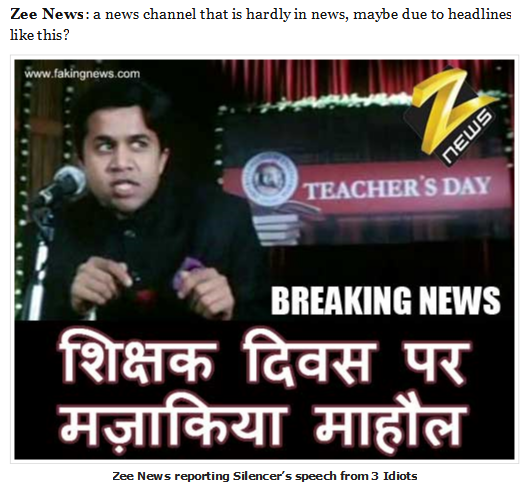
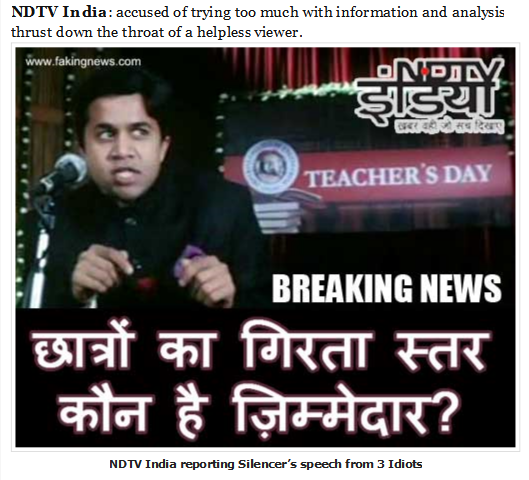
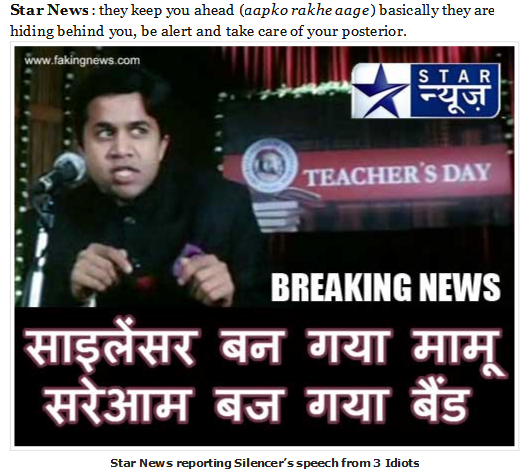
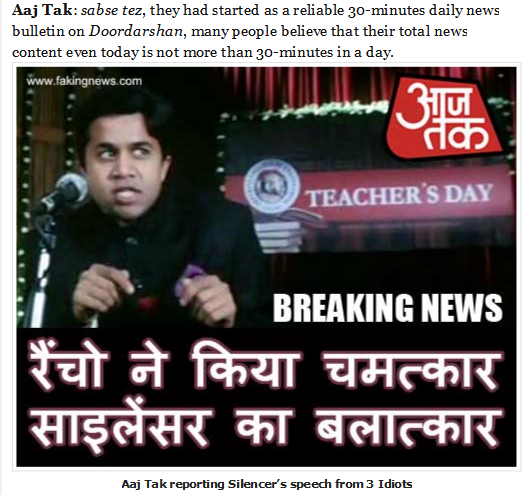
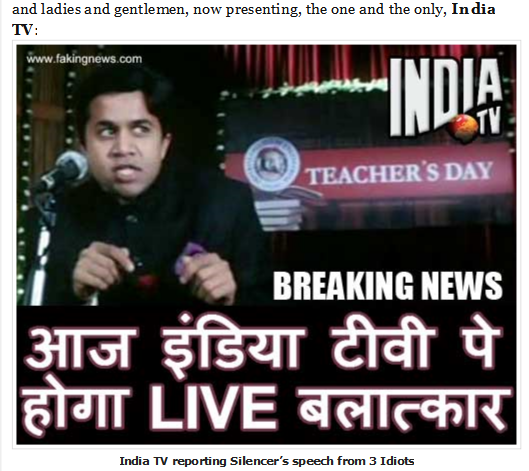
Source-
http://www.fakingnews.com/2010/01/if-news-channels-were-to-report-silencer-balatkar-speech-from-3-idiots/

A must read article by well known journalist Kanchan Gupta which shows the completely different and arguably the real story behind Kandahar unlike the hyped ones by the media and political opponents. Its a long article but its equally shocking as well. You should not miss this one and after this you will view the Kandahar episode in a completely different light. I have tried to highlight the important parts but I would still insist that you read the whole article.
_____________________________________________________
Kanchan Gupta
Was it really an ‘abject surrender’ by the NDA Government?
There have been innumerable communal riots in India, nearly all of them in States ruled by the Congress at the time of the violence, yet everybody loves to pretend that blood was shed in the name of religion for the first time in Gujarat in 2002 and that the BJP Government headed by Mr Narendra Modi must bear the burden of the cross.
Similarly, nobody remembers the various incidents of Indian Airlines aircraft being hijacked when the Congress was in power at the Centre, the deals that were struck to rescue the hostages, and the compromises that were made at the expense of India’s dignity and honour. But everybody remembers the hijacking of IC 814 and nearly a decade after the incident, many people still hold the BJP-led NDA Government responsible for the ‘shameful’ denouement.
The Indian Airlines flight from Kathmandu to New Delhi, designated IC 814, with 178 passengers and 11 crew members on board, was hijacked on Christmas eve, 1999, a short while after it took-off from Tribhuvan International Airport; by then, the aircraft had entered Indian airspace. Nine years later to the day, with an entire generation coming of age, it would be in order to recall some facts and place others on record.
In 1999 I was serving as an aide to Prime Minister Atal Bihari Vajpayee in the PMO, and I still have vivid memories of the tumultuous week between Christmas eve and New Year’s eve. Mr Vajpayee had gone out of Delhi on an official tour; I had accompanied him along with other officials of the PMO. The hijacking of IC 814 occurred while we were returning to Delhi in one of the two Indian Air Force Boeings which, in those days, were used by the Prime Minister for travel within the country.
Curiously, the initial information about IC 814 being hijacked, of which the IAF was believed to have been aware, was not communicated to the pilot of the Prime Minister’s aircraft. As a result, Mr Vajpayee and his aides remained unaware of the hijacking till reaching Delhi. This caused some amount of controversy later.
It was not possible for anybody else to have contacted us while we were in midair. It’s strange but true that the Prime Minister of India would be incommunicado while on a flight because neither the ageing IAF Boeings nor the Air India Jumbos, used for official travel abroad, had satellite phone facilities.
By the time our aircraft landed in Delhi, it was around 7:00 pm, a full hour and 40 minutes since the hijacking of IC 814. After disembarking from the aircraft in the VIP bay of Palam Technical Area, we were surprised to find National Security Adviser Brajesh Mishra waiting at the foot of the ladder. He led Mr Vajpayee aside and gave him the news. They got into the Prime Minister’s car and it sped out of the Technical Area. Some of us followed Mr. Vajpayee to Race Course Road, as was the normal routine.
On our way to the Prime Minister’s residence, colleagues in the PMO provided us with the basic details. The Kathmandu-Delhi flight had been commandeered by five hijackers (later identified as Ibrahim Athar, resident of Bahawalpur, Shahid Akhtar Sayed, Gulshan Iqbal, resident of Karachi, Sunny Ahmed Qazi, resident of Defence Area, Karachi, Mistri Zahoor Ibrahim, resident of Akhtar Colony, Karachi, and Shakir, resident of Sukkur City) at 5:20 pm; there were 189 passengers and crew members on board; and that the aircraft was heading towards Lahore.
At the Prime Minister’s residence, senior Ministers and Secretaries had already been summoned for an emergency meeting. Mr Mishra left for the crisis control room that had been set up at Rajiv Bhavan. In between meetings, Mr Vajpayee instructed his personal staff to cancel all celebrations planned for December 25, his birthday. The Cabinet Committee on Security met late into the night as our long vigil began.
Meanwhile, we were informed that the pilot of IC 814 had been denied permission to land at Lahore airport. With fuel running low, he was heading for Amritsar. Officials at Raja Sansi Airport were immediately alerted and told to prevent the plane from taking off after it had landed there.
The hijacked plane landed at Amritsar and remained parked on the tarmac for nearly 45 minutes. The hijackers demanded that the aircraft be refuelled. The airport officials ran around like so many headless chickens, totally clueless about what was to be done in a crisis situation.
Desperate calls were made to the officials at Raja Sansi Airport to somehow stall the refuelling and prevent the plane from taking off. The officials just failed to respond with alacrity. At one point, an exasperated Jaswant Singh, if memory serves me right, grabbed the phone and pleaded with an official, “Just drive a heavy vehicle, a fuel truck or a road roller or whatever you have, onto the runway and park it there.” But all this was to no avail.
The National Security Guards, whose job it is to deal with hostage situations, were alerted immediately after news first came in of IC 814 being hijacked; they were reportedly asked to stand by for any emergency. The Home Ministry was again alerted when it became obvious that after being denied permission to land at Lahore, the pilot was heading towards Amritsar.
Yet, despite IC 814 remaining parked at Amritsar for three-quarters of an hour, the NSG commandos failed to reach the aircraft. There are two versions as to why the NSG didn’t show up: First, they were waiting for an aircraft to ferry them from Delhi to Amritsar; second, they were caught in a traffic jam between Manesar and Delhi airport. The real story was never known!
The hijackers, anticipating commando action, first stabbed a passenger, Rupin Katyal (he had gone to Kathmandu with his newly wedded wife for their honeymoon; had they not extended their stay by a couple of days, they wouldn’t have been on the ill-fated flight) to show that they meant business, and then forced the pilot to take off from Amritsar. With almost empty fuel tanks, the pilot had no other option but to make another attempt to land at Lahore airport. Once again he was denied permission and all the lights, including those on the runway, were switched off. He nonetheless went ahead and landed at Lahore airport, showing remarkable skill and courage.
Mr Jaswant Singh spoke to the Pakistani Foreign Minister and pleaded with him to prevent the aircraft from taking off again. But the Pakistanis would have nothing of it (they wanted to distance themselves from the hijacking so that they could claim later that there was no Pakistan connection) and wanted IC 814 off their soil and out of their airspace as soon as possible. So, they refuelled the aircraft after which the hijackers forced the pilot to head for Dubai.
At Dubai, too, officials were reluctant to allow the aircraft to land. It required all the persuasive skills of Mr Jaswant Singh and our then Ambassador to UAE, Mr KC Singh, to secure landing permission. There was some negotiation with the hijackers through UAE officials and they allowed 13 women and 11 children to disembark. Rupin Katyal had by then bled to death. His body was offloaded. His widow remained a hostage till the end.
On the morning of December 25, the aircraft left Dubai and headed towards Afghanistan. It landed at Kandahar Airport, which had one serviceable runway, a sort of ATC and a couple of shanties. The rest of the airport was in a shambles, without power and water supply, a trophy commemorating the Taliban’s rule.
On Christmas eve, after news of the hijacking broke, there was stunned all-round silence. But by noon on December 25, orchestrated protests outside the Prime Minister’s residence began, with women beating their chests and tearing their clothes. The crowd swelled by the hour as the day progressed.
Ms Brinda Karat came to commiserate with the relatives of the hostages who were camping outside the main gate of 7, Race Course Road. In fact, she became a regular visitor over the next few days. There was a steady clamour that the Government should pay any price to bring the hostages back home, safe and sound. This continued till December 30.
One evening, the Prime Minister asked his staff to let the families come in so that they could be told about the Government’s efforts to secure the hostages’ release. By then negotiations had begun and Mullah Omar had got into the act through his ‘Foreign Minister’, Muttavakil. The hijackers wanted 36 terrorists, held in various Indian jails, to be freed or else they would blow up the aircraft with the hostages.
No senior Minister in the CCS was willing to meet the families. Mr Jaswant Singh volunteered to do so. He asked me to accompany him to the canopy under which the families had gathered. Once there, we were literally mobbed. He tried to explain the situation but was shouted down.
“We want our relatives back. What difference does it make to us what you have to give the hijackers?” a man shouted. “We don’t care if you have to give away Kashmir,” a woman screamed and others took up the refrain, chanting: “Kashmir de do, kuchh bhi de do, hamare logon ko ghar wapas lao.” Another woman sobbed, “Mera beta… hai mera beta…” and made a great show of fainting of grief.
To his credit, Mr Jaswant Singh made bold to suggest that the Government had to keep the nation’s interest in mind, that we could not be seen to be giving in to the hijackers, or words to that effect, in chaste Hindi. That fetched him abuse and rebuke. “Bhaand me jaaye desh aur bhaand me jaaye desh ka hit. (To hell with the country and national interest),” many in the crowd shouted back. Stumped by the response, Mr Jaswant Singh could merely promise that the Government would do everything possible.
I do not remember the exact date, but sometime during the crisis, Mr Jaswant Singh was asked to hold a Press conference to brief the media. While the briefing was on at the Press Information Bureau hall in Shastri Bhavan, some families of the hostages barged in and started shouting slogans. They were led by one Sanjiv Chibber, who, I was later told, was a ‘noted surgeon’: He claimed six of his relatives were among the hostages.
Dr Chibber wanted all 36 terrorists named by the hijackers to be released immediately. He reminded everybody in the hall that in the past terrorists had been released from prison to secure the freedom of Ms Rubayya Sayeed, daughter of Mufti Mohammed Sayeed, while he was Home Minister in VP Singh’s Government. “Why can’t you release the terrorists now when our relatives are being held hostage?” he demanded. And then we heard the familiar refrain: “Give away Kashmir, give them anything they want, we don’t give a damn.”
On another evening, there was a surprise visitor at the PMO: The widow of Squadron Leader Ajay Ahuja, whose plane was shot down during the Kargil war. She insisted that she should be taken to meet the relatives of the hostages. At Race Course Road, she spoke to mediapersons and the hostages’ relatives, explaining why India must not be seen giving in to the hijackers, that it was a question of national honour, and gave her own example of fortitude in the face of adversity.
“She has become a widow, now she wants others to become widows. Who is she to lecture us? Yeh kahan se aayi?” someone shouted from the crowd. Others heckled her. The young widow stood her ground, displaying great dignity and courage. As the mood turned increasingly ugly, she had to be led away. Similar appeals were made by others who had lost their sons, husbands and fathers in the Kargil war that summer. Col Virendra Thapar, whose son Lt Vijayant Thapar was martyred in the war, made a fervent appeal for people to stand united against the hijackers. It fell on deaf ears.
The media made out that the overwhelming majority of Indians were with the relatives of the hostages and shared their view that no price was too big to secure the hostages’ freedom. The Congress kept on slyly insisting, “We are with the Government and will support whatever it does for a resolution of the crisis and to ensure the safety of the hostages. But the Government must explain its failure.” Harkishen Singh Surjeet and other Opposition politicians issued similar ambiguous statements.
By December 28, the Government’s negotiators had struck a deal with the hijackers: They would free the hostages in exchange of three dreaded terrorists — Maulana Masood Azhar, Mushtaq Ahmed Zargar and Ahmed Omar Sheikh — facing various charges of terrorism.
The CCS met frequently, several times a day, and discussed the entire process threadbare. The Home Minister, the Defence Minister and the Foreign Minister, apart from the National Security Adviser and the Prime Minister, were present at every meeting. The deal was further fine-tuned, the Home Ministry completed the necessary paper work, and two Indian Airlines aircraft were placed on standby to ferry the terrorists to Kandahar and fetch the hostages.
On December 31, the two aircraft left Delhi airport early in the morning. Mr Jaswant Singh was on board one of them. Did his ministerial colleagues know that he would travel to Kandahar? More important, was the Prime Minister aware of it? The answer is both yes and no.
Mr Jaswant Singh had mentioned his decision to go to Kandahar to personally oversee the release of hostages and to ensure there was no last-minute problem. He was honour-bound to do so, he is believed to have said, since he had promised the relatives of the hostages that no harm would come their way. It is possible that nobody thought he was serious about his plan. It is equally possible that others turned on him when the ‘popular mood’ and the Congress turned against the Government for its ‘abject surrender’.
On New Year’s eve, the hostages were flown back to Delhi. By New Year’s day, the Government was under attack for giving in to the hijackers’ demand! Since then, this ‘shameful surrender’ is held against the NDA and Mr Jaswant Singh is painted as the villain of the piece.
Could the Kandahar episode have ended any other way? Were an Indian aircraft to be hijacked again, would we respond any differently? Not really. As a nation we do not have the guts to stand up to terrorism. We cannot take hits and suffer casualties. We start counting our dead even before a battle has been won or lost. We make a great show of honouring those who die on the battlefield and lionise brave hearts of history, but we do not want our children to follow in their footsteps.
We are, if truth be told, a nation of cowards who don’t have the courage to admit their weakness but are happy to blame a well-meaning politician who, perhaps, takes his regimental motto of ‘Izzat aur Iqbal’ rather too seriously.
Source-
http://www.dailypioneer.com/145600/The-truth-behind-Kandahar.html
Dummy voters at yesterday's civic polls
What happened:
MiD DAY caught on camera some Congress workers preparing fake Electoral Photo Identity Cards (EPIC) and using these to cast fake votes.
Dummy voters, brought in on Saturday, were made to masquerade as genuine voters. Their photos taken on Saturday night.
Yesterday, as genuine voters steamed into polling booths to cast votes, the Congress workers paid the genuine voters from Azad Nagar (ward 141) Rs 1,000 each to surrender their EPICs for a few hours and told not to cast their vote.
The Congress workers noted the genuine voters' details from their EPICs and entered these on fake cards kept ready. Photos of the fake voters were then pasted on them. These fake cards were designed as 'employment' identity cards.
The Election Commission (EC) has approved use of any photo identity, including office identity card, as valid ID proof to cast one's vote.
More than a vote:
The fake voters sauntered into the booths and cast their votes after flaunting the fake EPICs.
Outside, a few of their associates armed with a certain chemical to erase the indelible ink mark on their forefinger. Many fake voters re-entered the booths with a new fake EPIC to cast their vote again.
Officialspeak:
Bharatlal Meena, BBMP Commissioner, said, "If we come across such an irregularity, we will probe the case and refer it to the Election Commission."
The other side:
Congress candidate Gowramma's husband, C Govindaraju alias Jinke Govinda, said his party work had done no wrong. He said, "Those caught on camera are not my men."
'I don't know the full form of BBMP'
Name: Seema Khanum
Age: 30 years
Candidacy: Contesting on a Congress ticket from Jagajeenram Nagar (Ward no 136).
Qualification: A matriculate, Khanum is the wife of Altaf Khan, a local rowdy.
What is BBMP?
It is the corporation.
Do you know the full form of BBMP?
No. I don't.
All right, do you know where is the BBMP's head office?
I have seen it. It is somewhere in the city.
Do you at least know which election you are contesting?
Yes, that of a councillor.
Do you know what are the duties of a councilor?
Sorry, I don't. I'm not educated. But all I know is that a councillor should work for the people.
What do you intend to do for the people if you win the election?
My husband will look after it. I can't interact with people that well, as I can't speak any language other than Urdu.
Then how will you take part in the discussion at the BBMP council meetings?
I'll take my husband along.
Oh, I didn't know about it.
Link-
http://www.mid-day.com/news/2010/mar/290310-bogus-voting-civic-polls-EPIC-BBMP-polls.htm

She is the first Muslim candidate from the Bharatiya Janata Party to win by one of the largest margins in the BBMP elections. Syed Haseena Taj, who polled 11,428 votes from Mangammanapalya ward, was a busy woman on Monday taking part in processions throughout the day. Speaking on her behalf, her politician husband Syed Salam expressed their happiness. “She is very happy. People have supported her wholeheartedly,” he said.
Ms. Taj, once a homemaker, contested at the insistence of her husband. When asked why she chose the BJP ticket, Mr. Salam explained: “I was with the JD(S) for 15 years. But we both realised that parties that discriminate on the basis of religion are the JD(S) and the Congress, not the BJP.” He added that she would have won even as an independent candidate as people had faith in her reputation as a helpful person.
Source-
http://beta.thehindu.com/news/cities/Bangalore/article389352.ece